Get Full Government Meeting Transcripts, Videos, & Alerts Forever!
Get email alerts on the Bay Delta Water Quality Control Plan topic
No spam. Unsubscribe anytime.
SFPUC hears staff, conservation groups clash over Bay-Delta water plan and Tuolumne River flows
Summary
SFPUC staff warned a State Water Board proposal for higher unimpaired flows on the Tuolumne River could sharply increase rationing and require major new storage. Conservation groups and river advocates disputed that framing and urged support for higher flow targets, habitat investments and negotiated settlements. Public comments are due March 17, 2017.
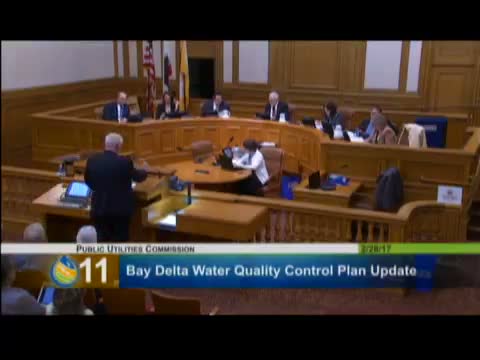
San Francisco — At a Feb. 28 meeting of the San Francisco Public Utilities Commission, staff laid out how the State Water Board's Bay-Delta Water Quality Control Plan amendment could affect the city's water supply and the Tuolumne River ecosystem, and drew sharp public response from conservation groups and river advocates.
Steve Ricci, Assistant General Manager for Water, told commissioners that under the state's proposed 40% unimpaired flow objective for February through June the utility would likely face significantly more frequent and deeper rationing years. Ricci said the agency's design-drought planning shows a potential 900,000 acre-feet storage gap that would need to be closed by new storage projects or other major investments such as groundwater banking, indirect potable reuse or a desalination facility. "If we had to contribute our share to the 40% unimpaired flow standard," he said, "we would be facing increased rationing years, rationing in dry years — first we see at the normal or contract level of demands, 50% rationing frequently."
Ricci framed alternatives that the SFPUC favors as part of a portfolio approach: targeted "functional flows" timed to key ecological needs, habitat restoration, predation control and improved hatchery management, combined with negotiated settlements rather than an immediate numeric mandate. He emphasized the agency's long-standing water-supply planning approach and the trade-offs inherent in numeric unimpaired-flow targets.
Conservation organizations and scientists disagreed with several of staff's policy conclusions. Peter Drechmeier of the Tuolumne River Trust said the SFPUC should correct widely circulated economic figures the trust regards as outdated, and urged the commission to support higher flow targets and adaptive management. John Rosenfield of the Bay Institute said the current problems in the Tuolumne and Bay-Delta stem from long-term unsustainable diversion and that the state's prior public-trust flow recommendations called for higher targets (60% of unimpaired flows as a basin-wide benchmark). Several speakers stressed science linking higher spring flows to increased salmon escapement and urged the commission to pursue measures that would achieve biological endpoints.
President Moran closed the discussion by summarizing the choices: revisit core planning policies, find additional supplies, or pursue different operational and habitat measures, and he reminded the public that State Water Board comments are due March 17 and that the board has indicated a possible adoption timeline of September 2017. The commission did not adopt a formal position at the meeting and indicated settlements and further negotiations with state and regional parties are ongoing.
What happens next: the SFPUC will continue stakeholder outreach and technical modeling, and the State Water Board public-comment deadline (per staff) is March 17, 2017. The Commission said it expects to return to the matter as settlement talks and state rulemaking advance.
Sources: Remarks and slides presented by Steve Ricci to the SFPUC and public testimony from advocates and science organizations during the Feb. 28 meeting.