Get Full Government Meeting Transcripts, Videos, & Alerts Forever!
Get email alerts on the Bay Delta Flow Proposal topic
No spam. Unsubscribe anytime.
SFPUC hears months-long debate over State Water Board's Bay-Delta flow proposal; staff warns of severe supply impacts
Summary
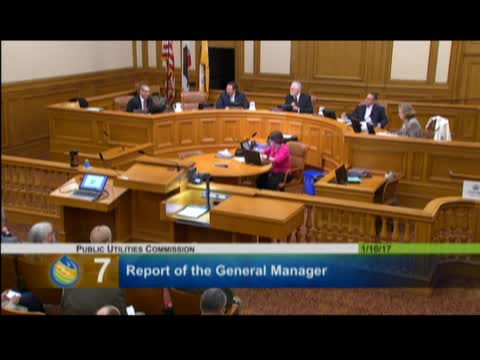
At a Jan. 10 SFPUC meeting, staff outlined the State Water Resources Control Board's revised plan to require 40% unimpaired flows Feb—Jun, warned of potential rationing and supply impacts, and heard more than three hours of public testimony from cities, businesses and environmental groups urging either settlements or stronger flows.
Steve Ritchie, assistant general manager for water, told the San Francisco Public Utilities Commission on Jan. 10 that the State Water Resources Control Board's revised Bay-Delta proposal would require 40% of unimpaired flows from key San Joaquin tributaries each year during February through June and include an adaptive band of 30% to 50%. He said the plan's mechanics, as currently framed, could force the SFPUC to contribute an unusually large share of required flows and would trigger deep mandatory rationing without major new supply investments.
"We could be required to contribute 52 percent of the required flow of the Tuolumne River per our agreement with the Turlock and Modesto Irrigation Districts," Ritchie said. "Without major investment in uncertain water supply projects ... we would not be able to meet our 184,000,000 gallon per day contractual obligations to our wholesale customers." He described storage increases this winter but warned that higher mandated flows applied in all years would markedly increase the frequency and severity of shortages compared with SFPUC planning assumptions.
The presentation framed the board's proposal as an attempt to protect fish and wildlife but said the SFPUC has "serious doubts" about aspects of the approach and the analysis of supply and socioeconomic impacts. Ritchie said SFPUC testified at the board's Jan. 3 hearing and is developing written comments in coordination with wholesale partners and irrigation districts. "We will be submitting written comments to the State Water Board," he said.
Public testimony that followed included more than 40 speakers representing local governments, environmental organizations, fishing and recreation groups, employers and residents. Sean Sherpentier, assistant city manager of East Palo Alto, told commissioners a 40% requirement could make essential affordable-housing projects infeasible for his city and urged SFPUC to support collaborative settlement discussions: "We have dire concerns about this proposed regulation," he said.
Environmental and fishing advocates, including representatives from the Sierra Club, Trout Unlimited and the Bay Institute, urged the commission to support the State Water Board's flow objectives or to press for even higher seasonal flows to protect salmon and estuarine ecosystems. Several speakers cited scientific assessments that they said recommend 50%–60% unimpaired flows during February through June to rebuild fish populations and estuarine function.
Business and regional groups, including the Bay Area Council and the San Francisco Chamber of Commerce, told the commission that the Bay Area economy depends heavily on Tuolumne supplies and urged negotiated voluntary agreements to avoid sudden cuts with substantial economic or housing impacts. Several local officials and developers described allocation problems and asked SFPUC staff to reconcile conflicting data and clarify what obligations are contractual versus subject to reinterpretation.
Commissioners asked staff to prepare clear, incontrovertible responses to specific public criticisms of the SFPUC's modeling and socioeconomic figures and to convene stakeholder meetings before the March deadline for written comments. Ritchie said the agency would pursue voluntary agreements where possible but cautioned that settlements will be "painful and costly" and that litigation without negotiation would prolong uncertainty.
The commission did not take a formal vote on a single position during the meeting; members instead directed staff to refine the analysis, to engage stakeholders and to return with more detailed information before filing formal comments with the State Water Resources Control Board.