Get Full Government Meeting Transcripts, Videos, & Alerts Forever!
Get email alerts on the Body Worn Cameras topic
No spam. Unsubscribe anytime.
Police Commission directs meet-and-confer on body-worn camera policy giving chief discretion in critical incidents
Summary
After hours of public comment and debate, the San Francisco Police Commission voted to send a body-worn camera policy (Version 3 with amendments) to labor meet-and-confer. The policy grants the chief discretion to allow officers to view footage in limited circumstances while retaining retention, audit, and disclosure safeguards.
The San Francisco Police Commission voted on Dec. 2 to direct staff to pursue a body-worn camera policy that, with amendments, gives the chief of police discretion to allow officers to view recordings in certain critical circumstances while preserving new audit, retention and disclosure rules.
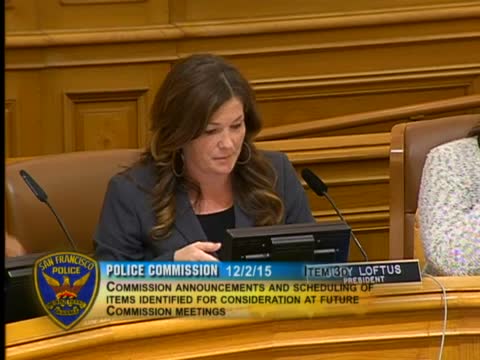
Commission President Loftus introduced the policy as the product of months of public meetings and working-group discussions and said the document reflects statutory changes including AB 69. "We've gone through this word by word," she said, noting new language on ownership, audits, notification, required activation events and retention.
Commissioner De Jesus argued for strict limits on pre-report viewing in officer-involved shootings and custody deaths, citing legal precedents. "Graham v. Connor says it's not what the officer knew in hindsight; it's what the officer knew at the time," she said, urging a policy that preserves an officer's independent recollection and then allows a supplemental report after viewing.
Other commissioners backed a narrower carve-out that would let the chief — or the chief's designee — decide whether viewing is appropriate in a given case. Commissioner Wong, who helped draft the compromise language, said the commission agreed on most of the policy and that the disputed language should be framed to preserve both transparency and investigatory flexibility: "We have a policy in front of us in which we agree on 99%." President Loftus said the commission would return to review the policy’s implementation after an audit period.
The public-comment period included hundreds of minutes of testimony from police officers, union leaders, civil-rights advocates, lawyers and residents. Marty Halloran, president of the San Francisco Police Officers Association, urged officers be allowed to view footage before finalizing reports so they can include all evidence in their initial statements: "The position of the POA has always been that members should be afforded the opportunity to view body worn camera video," he said. Advocacy groups and civil-rights lawyers, including ACLU organizer Tessa Cangelou and Public Defender Jeff Adachi, urged prohibiting pre-report viewing for incidents involving force to protect the evidentiary value of officers’ independent recollections.
On the specific motion — to adopt Version 3 with the commission’s amendments that limit pre-report viewing to the exceptions listed and vest decisional authority with the chief — Vice President Turman moved and the motion was seconded. Roll call produced these recorded positions: President Loftus — Yes; Vice President Turman — Yes; Commissioner Marshall — Yes; Commissioner De Jesus — Pass; Commissioner Mizuko — Yes; Commissioner Wong — Yes; Commissioner Malera — Yes. The motion carried.
The policy as framed in the motion includes: (1) a statement that BWC recordings are property of the department; (2) periodic and random audits for compliance; (3) minimum retention of 60 days with specified circumstances requiring two-year retention or longer (officer-involved shootings, recordings relevant to arrest/detention, complaints against members); (4) documentation requirements when a member deactivates a camera or a superior orders deactivation; and (5) prohibitions on tampering and unauthorized uploading to social media. The chair said the adopted direction will move to meet-and-confer with the Police Officers Association and the Department of Human Resources before final adoption.
Next steps: the commission directed staff to pursue meet-and-confer on the motion’s policy language and indicated it would schedule a return review — including an audit of the policy’s effects — after implementation (chair suggested a six-month review window as an initial target). The motion does not itself finalize a departmental general order; it sends high-level policy direction to bargaining and administrative processes that must be completed before final adoption.
The vote comes amid ongoing national debates about body cameras, public-records access, and investigatory best practices, and the commission’s action attempts to balance competing priorities: officer accuracy, investigative integrity, and public accountability.