Get Full Government Meeting Transcripts, Videos, & Alerts Forever!
Get email alerts on the Body Worn Cameras topic
No spam. Unsubscribe anytime.
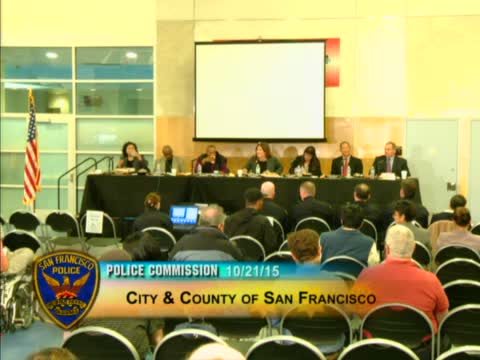
San Francisco Police Commission hears sharp divide over whether officers may view body-camera footage before statements
Summary
At a public meeting Oct. 21, 2015, the San Francisco Police Commission collected competing recommendations on a draft body-worn camera policy: police unions urged allowing officers to view footage before writing reports; the Office of Citizen Complaints and civil-rights groups urged narrow carve-outs barring such review in critical incidents and called for stronger public-release rules.
San Francisco '1 Oct. 2015 '015
The Police Commission convened a Tenderloin community meeting to gather public comment on a draft body-worn camera policy developed by a multi-stakeholder working group. The proposal, forwarded unanimously by the working group in August, lays out when officers should activate cameras, how long footage should be retained and rules for access and review.
Why it matters
The central dispute presented at the meeting was whether officers should be allowed to view body-worn camera footage before writing an initial incident report or giving a voluntary statement in critical incidents such as officer-involved shootings or in-custody deaths. Proponents argue pre-statement review produces more accurate reports and aids investigations; opponents say it can "contaminate" memory and undercut public trust in the investigative process.
What presenters told the commission
Commander Robert Moser, co-chair of the working group, told the commission the group's members included department personnel, the Office of Citizen Complaints, the Public Defender's Office, the San Francisco Bar Association, the ACLU, several unions and community representatives and that meetings and materials were posted publicly. He said the group reached agreement on many points but did not reach consensus on pre-statement viewing and retention length, and therefore presented both viewpoints to the commission for decision.
Marty Halloran, president of the San Francisco Police Officers Association, argued officers should be allowed to review footage before submitting reports so they can "produce the most accurate, thorough and complete report." He cited federal and academic studies he said support allowing officers to view footage and warned that barring review would prompt counsel to advise members not to provide voluntary statements.
Joyce Hicks, director of the Office of Citizen Complaints, urged a narrower approach. Citing memory-research by Elizabeth Loftus and others, Hicks recommended prohibiting pre-statement review in circumstances where an officer's perception is integral to the investigation '1 for example, critical incidents '1 and when an officer is the subject of a criminal or internal investigation. Hicks said she provided the commission with comparative policies (Oakland, San Jose, Fullerton) and three relevant articles to inform the commission.
Civil-rights and public-interest groups including the ACLU, Electronic Frontier Foundation and the Council on American-Islamic Relations urged the commission to prohibit pre-statement review in critical incidents and to adopt clear public-release rules, including proactive release for incidents of public interest such as officer-involved shootings.
Voices from the field and community
Many line officers, retired officers and union representatives testified that the ability to review footage is necessary to write accurate reports and to exonerate suspects quickly when footage shows no wrongdoing. "If video is the best evidence, then everyone has the right to view what occurred," said a Tenderloin officer representing the POA. Several speakers warned that requiring officers to write reports before viewing video could reduce voluntary statements and slow investigations.
By contrast, survivors and civil-liberties advocates said initial officer statements should reflect officers' independent perceptions. "They should not reflect one another," one member of the public said of reports and footage, arguing for preserving a separate written account and allowing supplements later.
Policy details highlighted
- Authorized activation: The working group recommended that cameras be department-issued equipment and listed specific instances when officers must activate them; it rejected a requirement for continuous recording.
- Viewing rules: The draft contains narrow carve-outs (subdivision F) under which officers would be barred from viewing footage before statements in certain critical incidents; the working group could not reach consensus on the scope of those carve-outs.
- Retention: The working group majority recommended a two-year minimum retention; an earlier recommendation had been one year. Members asked that a comprehensive cost-benefit analysis inform final retention decisions because storage costs rise substantially over time.
- Public release and discipline: Civil-rights groups asked for clear, categorical rules for releasing footage under the Public Records Act and for proactive release in cases of public interest. Commissioners also raised whether the policy should specify discipline for noncompliance beyond existing departmental processes.
What the commission will do next
President Susie Loftus closed the public-comment period and said the commission will deliberate the policy at its Nov. 4 meeting and consider final action at its first December meeting. The commission noted recent state changes (AB 69) and said it would seek advice from the city attorney to ensure compliance with state law.
Action taken
The commission took no policy votes at the Oct. 21 meeting; it did adopt a procedural motion to adjourn at the end of the session.
Quotes
"The members of the POA want to produce the most accurate, thorough, and complete report before submitting it," said Marty Halloran, president of the San Francisco Police Officers Association.
"Allowing an officer to review the video prior to giving a statement in serious use-of-force cases is a serious mistake," said Joyce Hicks, director of the Office of Citizen Complaints, citing memory research.
Next steps and context
The working group's final draft was dated Aug. 11 and was presented to the commission on Sept. 2. Commissioners indicated they were broadly aligned on routine, everyday cases but split on a small set of critical-incident carve-outs. The commission invited the district attorney's office to provide its position and will review legal guidance before formal deliberations.
Contact and public leads
During public comment a family member seeking information about a cold case asked members of the public to call an anonymous tip line at (415) 575-4444.
(Reporting based on the Police Commission meeting transcript, Oct. 21, 2015.)