Get Full Government Meeting Transcripts, Videos, & Alerts Forever!
Get email alerts on the Finance Audit topic
No spam. Unsubscribe anytime.
Port Authority reports dredging-driven deficit and readies capital-asset policy after audit finding
Summary
Finance officer Mr. Gunter reported a net loss of $147,005.25 through August largely due to $140,009.25 in dredging expenses; a State Board of Accounts audit found no fixed-asset policy, and staff distributed a draft capital asset policy for board review ahead of October adoption.
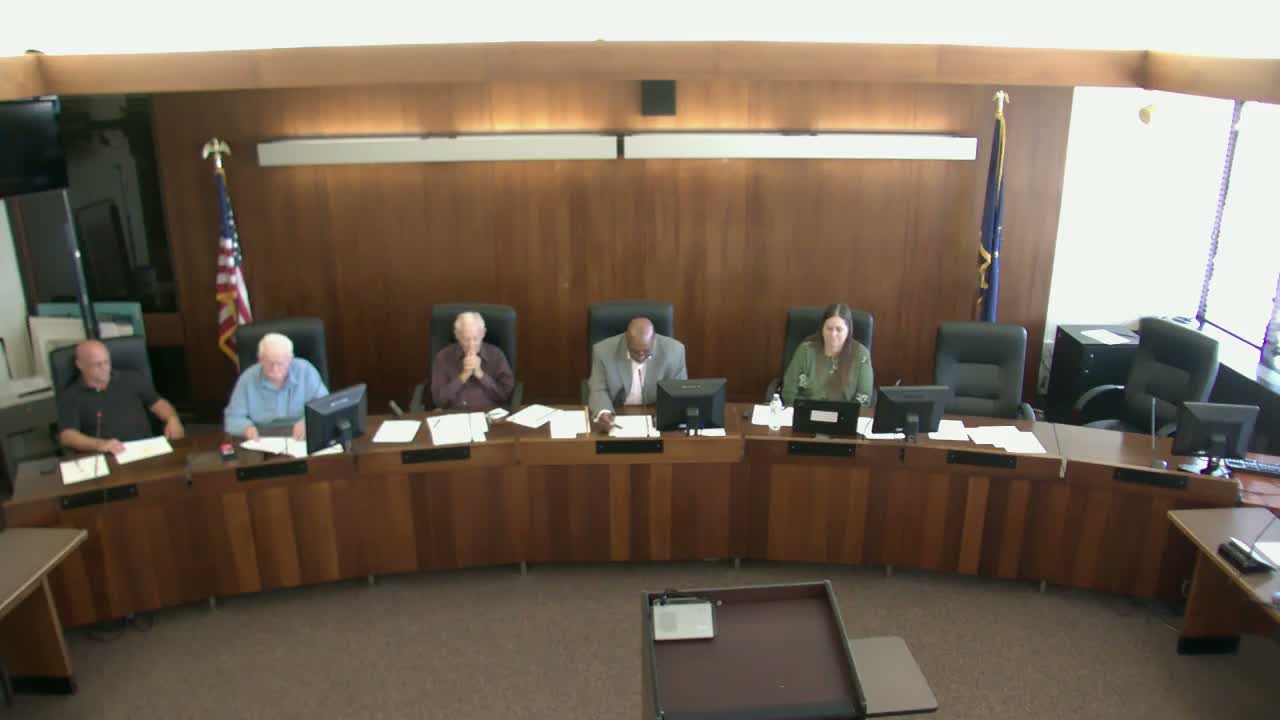
At the Port Authority of Evansville meeting on Sept. 9, Mr. Gunter presented the financial report through August and described a shortfall driven principally by dredging costs. "Expenses, a total of $249,002.13 ... had a net loss of a $147,005.25," he said, and noted cash and investments stood at $122,221.
Gunter explained revenue for the period included $5,438 in interest and $96,250 recorded as "other receipts," which he said is a transfer from the Parks Department that covers port shortfalls. Contractual services of $140,009.25 were identified as the dredging expense responsible for the bulk of the deficit.
Why it matters: The port dipped into reserves to cover dredging, prompting discussion of interfund transfers and future budgeting implications. Gunter told commissioners the Parks Department "makes up the difference" and that the $96,250 transfer for the period had already been made.
Audit finding and policy response: Gunter reported a State Board of Accounts compliance audit covering 01/01/2020–12/31/2023 that found the Port Authority did not have a fixed-asset policy. He circulated a draft capital asset policy and asked the board to review and mark it up; he recommended the board finalize comments within two weeks so the policy could be adopted at the October meeting. "The auditors require us to have a capital asset policy," he said.
Asset valuation questions: Commissioners asked about asset classifications and useful-life assumptions for depreciation (examples discussed included 20, 25 and 40-year horizons for improvements such as docks). Gunter cited acquisition costs for large items—he read a visitor center figure of $2,278,576 and another listed amount of $2,415,000—and offered to provide current book-value numbers for the board's review.
Accounts payable: The chair read an accounts payable voucher registry listing multiple invoices, including yearly liability insurance of $18,343.75, a $13,000 grant to the Evansville Wartime Museum, Indiana State Board of Accounts audit fees of $9,196, and several utility invoices. A motion to accept the accounts payable registry was seconded and carried.
Next steps: The board will review Gunter's draft capital asset policy, provide edits, and aim to have the policy adopted at the next meeting in October; staff will supply current book-value information and continue to coordinate with the Parks Department on transfers if necessary.