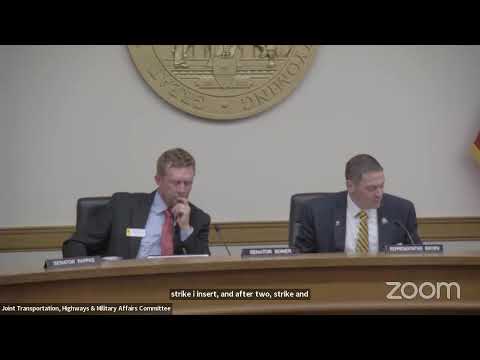
Committee reconsiders and advances ROTC endowment bill after technical fix
Summary
Members voted to reconsider 25LSO0080, removing an appropriation to avoid budgeting conflicts; University and ROTC leaders described cadet fundraising and limits on active-duty fundraising. The committee voted to re-sponsor the amended draft (9-5).
The Joint Transportation, Highways & Military Affairs Committee voted to reconsider and advance a corrected version of the ROTC endowment bill draft (25LSO0080).
Talise Hanson, staff attorney with LSO, said the amended draft removes an earlier $1 appropriation tied to the University of Wyoming's block grant that would have required importing part of UW—s budget tables into a policy bill. "At the chairman's direction, we just took out the appropriation at this time, for your guys' reconsideration," Hanson said.
University and ROTC testimony: Mike Smith of the University of Wyoming and lieutenant colonels representing Army and Air Force ROTC described cadet fundraising and limits on active-duty officers' fundraising roles. Lieutenant Colonel Paul Hanson said cadets raised about $14,800 on the university—s Giving Day and that active-duty staff generally advise rather than solicit donors.
Key vote: The committee first approved a motion to reconsider the earlier sponsorship and then voted 9-5 in favor of re-sponsoring the amended bill draft. Members discussed that removing the appropriation keeps the policy decision separate from the budget process and allows funding to be provided later in the budget bill or via private gifts.
What this means: The bill as amended would establish the ROTC endowment structure but leave any state appropriation to the budget process. The committee recorded the reconsideration and the committee sponsorship vote; no appropriation was added in this session.
AI generated
The text on this page is AI generated. Summaries, highlights, analysis, and video transcripts are all produced from the original source material.
AI can make mistakes, so if you spot one, and we will fix it for everyone.
Note: the source content is unaltered by us. Any content source we link to, be it a video, an audio recording, or a document, is presented exactly as its publisher released it. That publisher is usually a government body, sometimes an individual official or another organisation.