Get Full Government Meeting Transcripts, Videos, & Alerts Forever!
Get email alerts on the Land Use Variance topic
No spam. Unsubscribe anytime.
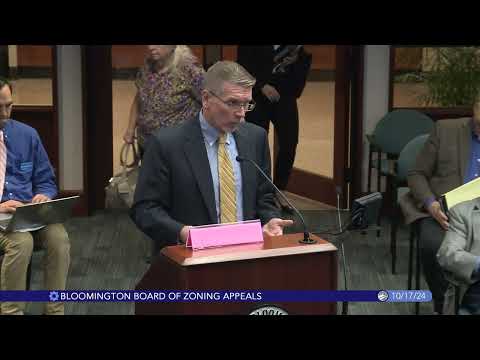
Bloomington BZA denies Slavens’ variances for front fence and circular driveway
Summary
The Board of Zoning Appeals denied two variances requested by Scott and Susan Slavin for a front fence taller than code and for a circular driveway at 2408 South Shadow Grove Court, finding staff’s development‑standards findings persuasive and noting easement and neighborhood‑character concerns.
The Bloomington Board of Zoning Appeals on Nov. 1 denied two variances sought by Scott and Susan Slavin that would have allowed a taller front fence and a circular driveway at their 1.28‑acre property at 2408 South Shadow Grove Court.
Joe Patterson, the city’s zoning and long‑range planner, told the board that staff found the property’s front limestone/wrought‑iron fence (about 6 feet) and 8‑foot side privacy fences did not meet Unified Development Ordinance (UDO) standards and conflicted with neighborhood character. He also said the proposed circular drive did not meet UDO frontage and access spacing requirements (about 100 feet of frontage vs. the 120 feet the code requires, and roughly 16 feet between access points instead of the 60 feet required). Patterson recommended denial.
Attorney Jason McAuley, representing the Slavens, said the property’s topography — “substantially lower than the properties to its east and west” — and severe foundation and drainage problems justified exceptions. McAuley told the board the couple had spent “over $200,000 recently on a retaining wall” and that the limited usable yard is primarily in front of the house, where they sought privacy and security.
Neighbors and nearby residents opposed the variances at the hearing. Ted Najam and Paul Newman said parts of the fence sit within a drainage and utility easement and showed photos they said depict water flow and a transformer affected by the fence. Newman called the fence “an ugly … plastic Berlin wall” and said it was installed without meaningful neighbor consultation. Najam asked the board to adopt staff findings and deny the petitions.
McAuley disputed that the Slavens intended to trap water and said riprap under the fence and other measures were intended to move water away from the house. He also argued that easement enforcement by private parties is distinct from the city’s authority, and that case law directs consideration of owner goals and peculiarities of the lot.
Board member Barry moved to deny both variance requests, citing staff’s findings on character, practical difficulty and injury to the public welfare. The motion passed by roll call; the board recorded an affirmative vote to deny both variances.
What’s next: The denial of the height and circular‑drive variances ends the Board’s review for this application; separate legal or administrative proceedings may still address fence location within the public drainage and utility easement, which staff said could require moving the fence regardless of the variance outcome.