Get Full Government Meeting Transcripts, Videos, & Alerts Forever!
Get email alerts on the Land Use Transmission topic
No spam. Unsubscribe anytime.
Umatilla planning panel adopts findings denying UEC transmission-line application over missing routing studies
Summary
The Umatilla Planning Commission on Oct. 22 adopted findings denying a UEC transmission-line siting application, concluding the applicant failed to place routing studies and sufficient evidence into the record; commissioners discussed statutory standards, potential appeal and next steps.
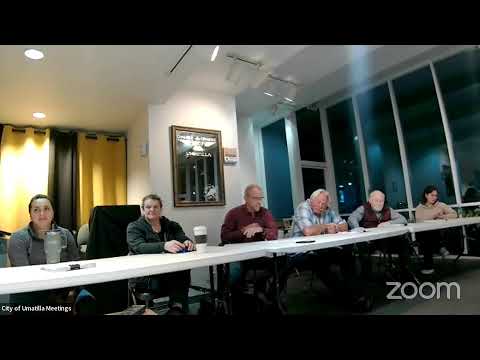
At its Oct. 22 meeting, the City of Umatilla Planning Commission adopted findings denying a UEC application to site a high-voltage transmission line, concluding the applicant did not file the underlying routing studies and evidence necessary for the commission to verify the chosen route.
City planning staff told the commission the public record and the applicant’s packet included only summary conclusions and a small set of appendices rather than the full routing analyses and scoring metrics the commission would need to evaluate alternative corridors. "We are denying strictly based on the routing and the lack of information that UEC provided," a staff member said during the presentation, urging the commission to base any decision on evidence in the record.
The staff presentation distilled public comment into five main categories: routing alternatives; wildfire and fire-mitigation information; views and property-value impacts; noise, electromagnetic-field and health concerns; and the feasibility of undergrounding the line. Staff said the applicant’s renderings and design changes appeared to meet the city’s aesthetic/"design" requirements for view impacts, and that noise and fire construction standards are largely governed by state and federal codes. But staff emphasized the routing question — whether the proposed corridor is the appropriate site compared with alternatives inside the city’s urban growth boundary (UGB) — remained unresolved without the routing studies.
Commissioners pressed staff about whether the written findings should focus narrowly on the routing standard or also elaborate on other issues raised by public testimony. Commissioners noted opponents had cited state land-use statutes about siting on exclusive farm use (EFU) land. Staff said they referenced applicable ORS statutes (state statutes governing siting and uses in EFU zones) and the Umatilla County development code in the draft findings but reiterated the legal constraint that the commission must rely on the evidence already in the record rather than inserting new analysis after hearings.
Several commissioners expressed concern that statute citations and some testimony might not have been fully captured in the draft findings. Staff responded that they had tried to include each ORS citation heard on the record but apologized if any were missed and said they would review the audio and finalize the decision order. Staff also noted that some wildlife concerns involve federal property managed by the U.S. Army Corps of Engineers; the Corps’ easement review, if issued, would address federal permitting for those federal lands.
Chair Bruce McLean called for a motion to adopt the findings as written; a motion and second were made and the commission took a voice vote. Several commissioners voiced "Aye" and at least one commissioner said they were not comfortable signing without reviewing all citations, but the motion carried and staff said they would finalize and sign the decision order.
The staff memo and the commission’s denial rest on the procedural point that LUBA (the state Land Use Board of Appeals) and other review bodies evaluate local decisions based on the administrative record. Staff told commissioners it is possible the applicant could press parts of the record or pursue appeals: if UEC appeals to LUBA, LUBA will generally review whether the local decision was supported by evidence in the record rather than allowing new evidence to be added on appeal.
Next steps: staff will finalize and sign the decision order reflecting the adopted findings. The commission was informed of the possibility of an appeal to LUBA and of the procedural limits on adding evidence after the record closed.
The meeting closed after brief announcements from staff about required ethics training for commissioners, a planned laptop rollout, a Nugent Park ribbon-cutting and a bridge construction update.