Get Full Government Meeting Transcripts, Videos, & Alerts Forever!
Get email alerts on the Homelessness Policy topic
No spam. Unsubscribe anytime.
Staff says Oregon law and HB 3115 let Umatilla regulate public camping; PATH shelter update shows partial occupancy
Summary
City staff briefed council on the recent U.S. Supreme Court decisions and Oregon's House Bill 3115, explaining local authority to regulate time, place and manner for public camping; staff also reported PATH shelter operations with 32 overnight beds and ISU units in use.
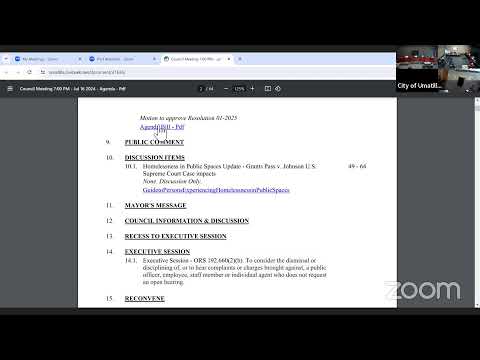
City staff briefed the Umatilla City Council on recent legal developments affecting municipal regulation of camping in public spaces and provided an operational update on the PATH shelter and individual shelter units (ISUs).
Using guidance from the League of Oregon Cities, staff summarized the U.S. Supreme Court rulings discussed in the meeting and explained that Oregon's House Bill 3115 codified aspects of Martin v. Boise. Staff said the Supreme Court's recent decisions do not remove Oregon's ability to regulate public camping because the state legislature adopted HB 3115; the law allows municipalities to adopt and enforce time, place and manner restrictions if publicly funded sheltering is available and conditions are objectively reasonable.
Staff noted that the practical effect of the Supreme Court ruling is small in Oregon because state law already incorporates the Martin v. Boise protections; however, staff said the phrase "objectively reasonable" remains vague and will likely require future case law to define. Staff cited the Robinson decision (as discussed in the guidance) and said Robinson concerns status-based punishment while local public camping ordinances regulate actions by any person.
On PATH operations, staff reported the overnight facility has 32 beds and averages about 13 occupants per night; the ISU program has 21 units with seven currently in transitional housing. Staff described operational challenges adapting ISUs to commercial building and fire codes because the shelter has become a public commercial building with different occupancy and egress requirements; staff and contractors are addressing issues like installing ranges and ovens and determining occupancy rules for couples and trundle beds.
Staff said a cleanup operation was planned for an area near the marina and that individuals previously camping there had been cited, entered PATH or arranged alternative options. Council asked for trends over time and staff said a more detailed update will be returned at the next meeting.
No ordinance changes or enforcement actions were taken at the meeting; staff provided this briefing to clarify legal authorities and local operational status.