Get Full Government Meeting Transcripts, Videos, & Alerts Forever!
Get email alerts on the Public Safety topic
No spam. Unsubscribe anytime.
Crescent City council approves five-year body-camera and evidence-storage contract
Summary
The Crescent City City Council voted unanimously to approve a five-year contract option to consolidate body cameras, tasers and evidence storage for 18 positions, authorize the city manager to sign the contract and cap reserves and community-service officer equipment under the plan.
CRESCENT CITY, Calif. — The Crescent City City Council voted unanimously to approve a five-year contract to consolidate the city—s body-camera, taser and evidence-storage services, authorizing the city manager to sign the agreement.
Council members approved "Option 1," a combined contract covering 18 positions, after a public meeting required by state law on the city—s military equipment use policy. The police chief recommended the combined contract as the most efficient approach; staff said the five-year total is just under $300,000 with a first-year cost of about $60,005.70.
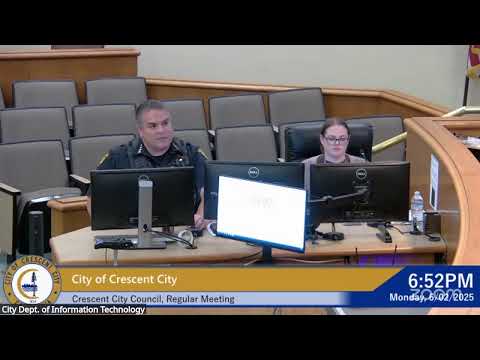
"It's an insurance policy for the city," the Police Chief said, describing the system—s automatic activations (when an officer draws a firearm, deploys a taser or operates lights-and-sirens), a 30-second pre-record buffer, redaction tools and remote monitoring that staff can access during critical incidents. He said the department has used Axon-style systems for years and that audit trails log every action in the evidence system.
Public commenters asked whether footage could be deleted and whether the 30-second pre-roll was long enough. "Any action in evidence.com is logged," the Police Chief said, adding that deletions require a stated reason, are logged, and that statutory retention schedules (for example, misdemeanors) mean some footage is routinely removed after retention periods expire.
Council members discussed staffing tied to the contract. The chief said the contract would cover body cameras for two reserve peace officers (both described as former officers and one named in the meeting as Magnolia Valero, currently volunteering in the front office) and a proposed non‑sworn community service officer (CSO) who would be unarmed but wear a camera to support code enforcement and other duties.
The motion to approve Option 1 and authorize the city manager to execute the contract passed by roll call vote (Dooley: yes; Tinkler: yes; Mayor Pro Tem Wright: yes). Council did not change the procurement approach on the dais but directed staff to proceed with contract execution and bring ordinance language for reserves, as needed.
The public-meeting portion of the military equipment policy process proceeded separately; staff said the equipment described in the policy reflects items the state classifies as "military equipment" for reporting purposes and does not include major military hardware such as MRAPs or surplus 1033 equipment.