
State Board reviews Nebraska Literacy Project; NDE asks members to delay formal approval until February
Get AI-powered insights, summaries, and transcripts
Subscribe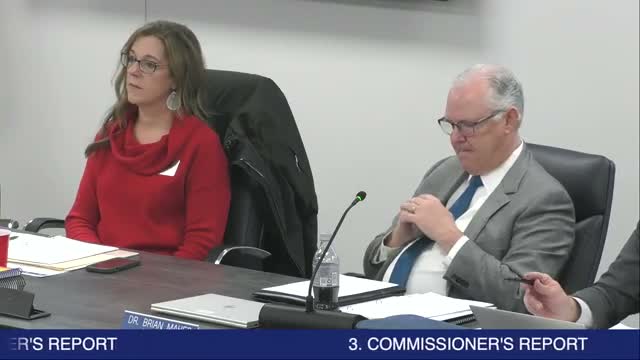
Summary
The Nebraska Department of Education presented a statewide literacy plan that aims to lift third-grade reading proficiency to 75% by 2030 and to expand an evidence-based professional learning system. Commissioner Maher asked the board to take no action until February so new members can review details and staff can refine the plan.
The State Board of Education heard a briefing on the Nebraska Literacy Project on Jan. 10, 2025, and the Department of Education asked the board to delay any vote until its February meeting.
Lane Carr, from the NDE Office of Policy and Strategic Initiatives, said the plan sets an aspirational target “to increase third grade proficiency on the NSCAS ELA assessment to 75% by 2030.” The plan builds on the Reading Improvement Act and recent statutory changes that call for a professional learning system, regional literacy coaches, family literacy centers and program evaluation.
NDE academic officer Allison Dinbesti and Carr outlined five tenants of the project: establishing a professional learning system for teachers, supporting standards-aligned instructional materials, deploying regional literacy coaches through Educational Service Units (ESUs), building an evaluation and data-collection framework, and expanding family literacy and early-childhood supports. Carr noted university partnerships and listed three university programs currently supported through the plan’s professional-learning work.
Commissioner Merrick Maher told board members the department will return in February with an updated document and asked members to submit suggested edits by Jan. 24. Maher said the request for delay was grounded in two concerns: remaining details needing work and giving new board members time to review and question plan elements before a final vote.
The presenters discussed funding and sustainability. They said some activities have ESSER funding and other time-limited supports, including the Nebraska Growing Readers initiative (an ESSER investment that has distributed about 800,000 books), and the department is working on an evaluation to identify elements that should be sustained beyond one-time federal relief. Lane Carr and Dr. Larry Ann Polk, CEO of the ESU Coordinating Council, described collaboration between NDE and ESUs on coaching, training deployment and data reporting.
Board members asked who authored the plan (NDE staff across offices with contributions from policy, special education and others), how partners such as the Nebraska Children and Families Foundation are funded (through ESSER for the Growing Readers work), and how the department will determine “high-quality instructional materials” (NDE cited EdReports, the Reading League and external reviews as tools currently used). Members were given an opportunity to ask detailed questions about program evaluation, job descriptions for proposed regional literacy coaches, and long-term funding options after ESSER expires.
Because the department asked for a delay, the board took no formal action on the literacy plan at the Jan. 10 meeting. NDE staff said they will return to the board in February with an updated plan and supporting details.