Get Full Government Meeting Transcripts, Videos, & Alerts Forever!
Get email alerts on the Housing Policy topic
No spam. Unsubscribe anytime.
St. Helena workshop reviews state housing laws as residents press for local protections and worker housing
Summary
A joint City Council–Planning Commission workshop featured land-use attorney Barbara Katz summarizing recent California housing laws and their effects on local review; residents urged the city to prioritize worker housing, protect agricultural land and clarify evacuation, water and RHNA questions.
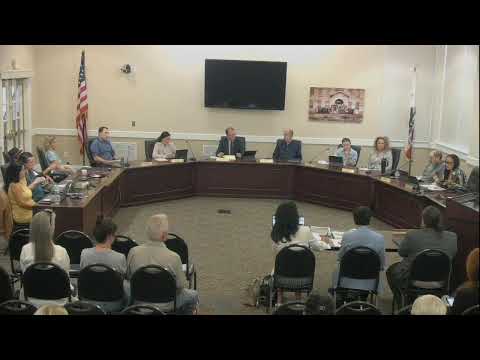
St. Helena held a joint workshop of the City Council and Planning Commission on state housing legislation and its potential effects on local policies. Land-use attorney Barbara Katz reviewed major laws and court rulings since 2017 and answered residents’ questions at a packed City Hall session.
Katz told the meeting that state policy has steadily constrained local discretion over housing approvals: "the point is to curb the capability of local governments to deny or reduce the density of or make housing development projects infeasible," she said. City staff summarized local context: Saint Helena’s housing element was adopted in September 2023, the city’s RHNA allocation is 256 units, and current pipeline projects total about 156 units (including the Hunter Subdivision ~75 units plus 11 ADUs, a 10‑unit 100% affordable project on Pope Street, and the Spring Grove Townhome site proposed for 41 units). A community‑identified site at 1933 Spring Street drew attention but has no formal application on file.
Why it matters: Katz described several legal mechanisms that reduce local veto power: preliminary applications can vest local standards in effect when filed; a five‑meeting cap limits the number of public hearings a city may hold for a housing project once an application is complete; objective standards (height limits, setbacks, floor‑area ratios) are the permissible basis for denial while subjective design or “compatibility” findings are risky; density‑bonus law allows waivers of many local rules for qualifying affordable projects; and recent budget‑trailer provisions create expanded CEQA exemptions for many infill projects.
During public comment, residents pressed the council on several recurring concerns. Michael Morrison proposed donating city land for 50 units of employee housing, saying the city could “donat[e] some city land to build housing for local employees.” Multiple speakers criticized past upzoning and asked for follow‑up disclosure about the 1933 Spring Street designation, citing impacts on immediate neighbors and the town’s agricultural character. Several speakers raised fire‑evacuation and water‑supply concerns as potentially qualifying objective public‑health or safety standards that could limit projects, and others warned that a high share of second‑homes was hollowing the community.
On technical points, Katz and staff clarified that RHNA allocations cannot be changed mid‑cycle (the next cycle is 2031), that state rules sometimes require using gross site area when computing base density under certain density‑bonus calculations, and that CEQA exemptions for infill have specific size, prior‑use and resource exclusions (prime agricultural land, wetlands, certain conservation areas and hazardous locations). Katz gave Napa County illustrative income thresholds (she cited low‑income single‑person up to about $90,000 and low‑income family of four up to about $128,000) to underscore how "affordable" is often a county‑specific number.
Council and commission members said they would take a series of follow-up steps rather than a single policy change: review and strengthen objective health and safety standards (sidewalks, evacuation metrics, water access), inventory historic resources used to qualify projects for protection, examine zoning‑code implementation and outreach practices, and consider state‑level advocacy. No new ordinance or project approvals were adopted at the workshop; the only formal action recorded on the agenda was a voice vote to adopt the evening’s agenda.
The council directed staff to return with proposals and options for additional study and community outreach, including a possible focused follow‑up meeting on site‑specific concerns. Staff and the planning commission signaled an intention to examine zoning‑code performance and public‑engagement practices in light of the state laws Katz described.