Get Full Government Meeting Transcripts, Videos, & Alerts Forever!
Get email alerts on the Land Use Zoning topic
No spam. Unsubscribe anytime.
Residents Press Passaic City Council to Remove High‑Rise Conditional Use from R‑1A Zoning
Summary
Residents and neighborhood groups urged the Passaic City Council to amend the R‑1A zoning district to remove the conditional‑use allowance for high‑rise buildings, citing the city’s 2013 master plan and a 2024 reexamination and presenting a petition and draft ordinance language.
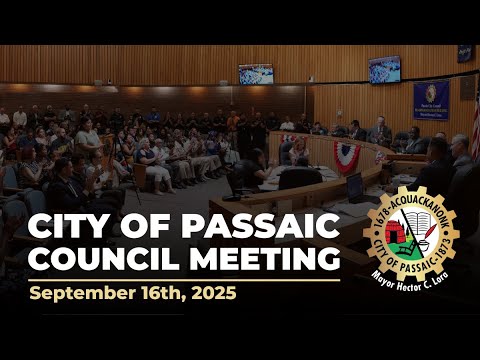
Dozens of residents urged the Passaic City Council on Sept. 16 to amend the R‑1A zoning district to remove a conditional‑use allowance for multi‑family high‑rise buildings, saying the change would protect neighborhood safety, parking and the scale of longstanding single‑ and two‑family streets.
Joshua Goldman, a resident who returned to the council after raising the issue in May, asked officials to “pass an ordinance to amend the zoning ordinance to remove the conditional use of high rises in the R‑1A District,” and cited the city’s master‑plan language recommending removal of four‑story‑plus multifamily conditional uses. Goldman said he had met with the mayor, the business administrator and the council and that the master‑plan analysis from 2013 supported the revision.
Speakers representing nearby blocks described narrow streets, nearby schools and synagogues, and heavy pedestrian flows. Razele Asa said the area “includes a private school that many children walk to and from every day” and that adding high‑density housing there would “significantly increase traffic, congestion, and parking pressures,” putting children at greater risk. Leah Zimmerman and other neighbors described parking squeeze, sight‑line and livability concerns if proposed projects of 150–200 units were built behind existing houses.
Steve Weisman told the council a petition with nearly 400 signatures and drafted ordinance language was ready for introduction; he urged council members to act so the city would not send an implicit signal to developers that the status quo permits large projects. Yitz Weiss asked the council for concrete next steps and guidance for neighborhood organizers.
City staff and the business administrator explained the legal and procedural options. The business administrator and the city’s planner traced the R‑1A district’s origin to planning in the 1950s and described the conditional‑use thresholds that can trigger planning‑board review (e.g., buildings of 5 stories or more or large unit counts) and the requirement that the planning board assess consistency with the municipal master plan. Staff cautioned that the council can change ordinances but must account for state Municipal Land Use Law procedures, planning‑board consistency reviews and potential litigation if an ordinance is inconsistent with the master plan.
Council members and staff said attorneys would review any draft ordinance submitted by residents and that difficult legal questions may require private discussions; the administration said it had been exploring alternatives and potential incentives to redirect development but could not publicly disclose details for legal reasons.
The public‑comment period closed after the council heard multiple speakers. Council members did not vote on a zoning change at the meeting; next steps described at the meeting included attorney review of resident‑drafted language and the formal ordinance process—if the council decides to introduce an amendment, it would go through the planning‑board consistency review and subsequent public hearings.
Authorities cited at the meeting included the city’s 2013 master plan, the 2024 master‑plan reexamination referenced by speakers, and the state Municipal Land Use Law; the transcript also recorded participants’ references to state encouragement of urban transit‑oriented development. Residents’ advocates said they had both the language and signatures ready and requested council action to prevent further out‑of‑scale applications.
The council did not make a final decision on rezoning at the Sept. 16 meeting; staff said attorneys would examine the petition language and the administration would report back when appropriate. The meeting record included multiple technical clarifications about the conditional‑use review process, traffic and infrastructure studies required of applicants, and the burden of proof that lies with applicants before planning or zoning boards.
Provenance: topicintro SEG 377; topfinish SEG 1832.