Get Full Government Meeting Transcripts, Videos, & Alerts Forever!
Get email alerts on the Accessory Dwelling Units topic
No spam. Unsubscribe anytime.
Norwalk planning commission recommends ADU ordinance with current accessory-structure setbacks
Summary
The Planning & Zoning Commission on Aug. 25 voted unanimously to recommend a zoning amendment aligning the city's accessory dwelling unit rules with a new state law and to retain the city's existing (more permissive) accessory-structure setbacks so more lots can accommodate ADUs. The measure moves to city council on Sept. 8, 2025.
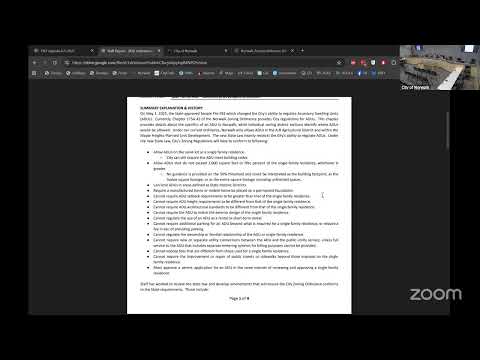
The Norwalk Planning & Zoning Commission voted unanimously Aug. 25 to recommend a zoning ordinance amendment to conform city code with a recently passed state senate file governing accessory dwelling units, choosing to retain the city's existing accessory-structure setbacks rather than adopt the stricter principal-building setbacks the state allows.
Elliot, a community development staff member who briefed the commission, said the new state law narrows what local governments may regulate about ADUs and requires the city to update its ADU chapter and definitions. "It's a little frustrating, the state kind of removing the city's local control on such issues," Elliot said, while noting that ADUs can help create affordable housing and support aging in place.
Under the options presented, the commission could have required ADUs to meet principal-dwelling setbacks — a larger "box" that, for R-1 lots, the staff described as roughly 7 to 8 feet on the sides and 30 to 35 feet from the front and rear — or treat ADUs as accessory structures with smaller setbacks (5 feet from side and rear lot lines and a 10-foot minimum separation from the principal dwelling). Commissioners and attendees said the smaller accessory-structure setbacks would make ADUs feasible on more of Norwalk's typical lots.
The commission also discussed technical constraints: the state law prevents cities from restricting an ADU's use as a rental or short-term rental, and it generally bars local height restrictions that differ from single-family residential height (staff cited 35 feet as the relevant single-family height). Elliot noted the city can still require building permits, site-plan review, inspections and separate metering, but it cannot require a separate connection to the city main.
After public input and discussion, Chair proposed a motion "that approves the zoning amendment with the change to the setbacks consistent with our current accessory building unit setbacks." Commissioner Sam moved the motion; Thompson seconded. Hillary called the roll: Samuelson, Forrest, Eaton, Henders, Thompson and Reagan each voted "aye." The motion passed unanimously. The commission closed the public hearing at 6:02 p.m.
The commission's recommendation will go to the Norwalk City Council at its next meeting; staff indicated the item will appear on the Sept. 8, 2025 agenda. The planning staff said it can later return to the council to seek additional tweaks if Norwalk finds problems in practice.