Get Full Government Meeting Transcripts, Videos, & Alerts Forever!
Get email alerts on the Infrastructure Sewer topic
No spam. Unsubscribe anytime.
Paradise council backs locally scaled sewer project, asks staff to pursue $36.7M reallocation
Summary
The Paradise Town Council voted unanimously to adopt Resolution No. 202567, selecting a hybrid gravity/STEP collection system with aerated-lagoon treatment and land-discharge ponds for a phased sewer project and directing staff to pursue reallocation of CDBG‑DR funds to cover a remaining funding gap.
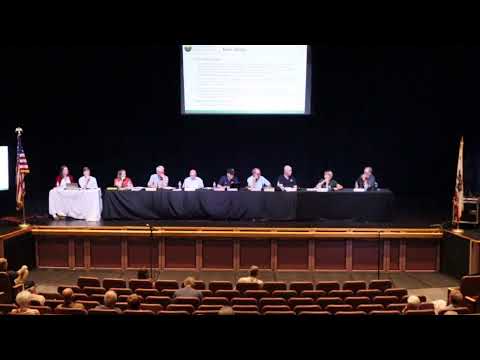
The Paradise Town Council on Monday voted unanimously to adopt Resolution No. 202567, approving staff’s recommendation to advance a locally scaled Paradise Sewer Project and to pursue amendments to the town’s CDBG‑DR infrastructure allocation to cover a remaining funding gap.
Mark Maddox, the town’s public works director and engineer, told the council the ad hoc committee recommended a hybrid collection system — shallower gravity mains on main corridors with septic tank effluent pump (STEP) connections for low-elevation properties — paired with aerated lagoon treatment and land-discharge evaporation/percolation ponds. “We have never been closer to a constructible project,” Maddox said, urging the council to move quickly because temporary federal and state recovery funds have limited windows.
The council’s decision follows months of alternatives analysis and stakeholder outreach. Maddox said secured funding for the project totals roughly $84 million and that conservative, high-end construction estimates project the total capital need at about $114 million, leaving an approximate $30 million shortfall. Staff proposed three options to cover that gap and recommended reallocating $36.7 million from the town’s existing CDBG‑DR infrastructure allocation — an approach that would suspend or retool a portion of the Railroad Extension project and require negotiation with state and federal funding partners to avoid de‑obligation.
The plan is phased: an initial service area in the downtown core would be prioritized, with later expansions and design adjustments possible after environmental review and permitting. Maddox estimated the treatment facility for the initial 0.1 MGD (100,000 gallons per day) phase could require roughly 5 acres for initial discharge and about 17 acres at full phase‑1 buildout, and he projected a construction window of roughly 2027–2029 after the subsequent programmatic environmental impact report (EIR) and right‑of‑way acquisitions.
Regulatory and technical partners at the meeting endorsed the approach. Clint Snyder, assistant executive officer with the Central Valley Water Board, said the aerated-lagoon and land‑discharge approach is well understood and permitable. “They’re easy to plan for and really easy to permit,” Snyder said, adding that the option is straightforward to operate and expand over time.
Residents and technical stakeholders urged caution and asked that additional alternatives be included in the EIR. Public commenters raised several recurring concerns: whether connection to the new system would be mandatory or optional (staff said connection policy has not been decided and that new development could be required to connect), how lateral and service stub installation would be handled for vacant parcels, the long‑term operations and maintenance (O&M) costs and staffing needs, and public‑health risks from ponded discharge (the Butte County Mosquito and Vector Control District urged early design coordination to avoid mosquito breeding habitat).
Maddox said staff estimates annual O&M for the initial facility in the range of $300,000–$800,000 and expects two to three full‑time operations staff in the startup period; the council previously set aside a project reserve that staff proposes to use to subsidize rates early on and target an average monthly household wastewater rate near $85 for the first 10 years.
The motion, made by Council member Lang and seconded by Council member Lasagne, directs staff to immediately commence environmental and design activities for the selected alternative, to reengage funding partners about reallocating CDBG‑DR funds toward the sewer project, and to bring back formal revisions to the town’s CDBG‑DR infrastructure action plan for council consideration. The motion passed 5–0 (Council member Boland — Aye; Council member Cullerton — Aye; Council member Lang — Aye; Council member Lasagne — Aye; Mayor Carter — Aye).
Next steps include authorization to begin the programmatic EIR, identify and evaluate candidate treatment and discharge sites during that process, continue grant and appropriation advocacy (including for U.S. Army Corps and State Water Board support), and return to the council with more detailed cost allocations, contract recommendations and the proposed CDBG‑DR amendment for formal action.
Council members and staff emphasized the trade‑offs involved in reallocating recovery funds from other projects and promised additional community engagement and technical analysis during the EIR and design phases.
The council adjourned after the vote; staff said they expect to return with a formal funding‑plan amendment and a timeline for the environmental review at a subsequent meeting.