Get Full Government Meeting Transcripts, Videos, & Alerts Forever!
Get email alerts on the Library Funding topic
No spam. Unsubscribe anytime.
County commissioner outlines library-levy trade-offs and flags housing, mental health as top priorities
Summary
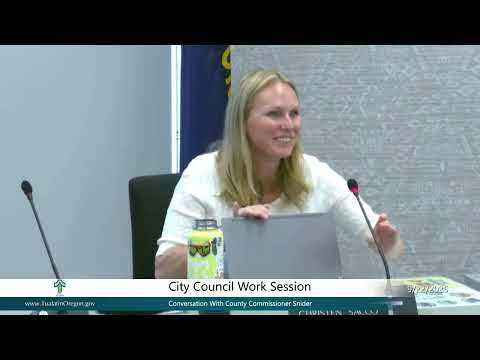
Washington County Commissioner Jason Snyder told the Tualatin City Council that county library-levy allocations are being adjusted to serve underserved, unincorporated areas and that the county’s top priorities are housing and mental-health services amid uncertain funding.
Washington County Commissioner Jason Snyder on Monday told the Tualatin City Council that the county is reworking how library-levy dollars are allocated to address long-standing inequities between incorporated cities and unincorporated urban areas.
Snyder said the county’s allocation formula has shifted more levy funding toward nonprofit libraries that serve unincorporated neighborhoods, and that any county decision to increase support for those nonprofit libraries would mean less money available for other levy-supported services. “That would be equivalent to the same as the county contributing more,” Snyder said, describing the trade-off facing commissioners.
Councilors sought clarification about why nonprofit libraries, which do not levy taxes, are receiving county levy money. Councilor Pratt asked whether city residents are effectively paying to support libraries outside city limits; Snyder replied that nonprofit libraries have no independent taxing authority and that changes to the allocation formula are the practical avenue for redirecting support. Snyder emphasized the commission’s intent to be equitable while acknowledging political and fiscal constraints in guaranteeing future increases.
Snyder also listed housing and mental-health services as the county’s top near-term priorities and warned that funding for those programs is “less certain than it was 9 months ago.” He said the county is reviewing revenue options and watching the legal and legislative landscape, adding that county staff are evaluating revenue sources the county has not historically pursued, such as franchise fees on rights-of-way.
On the question of scale, Snyder told councilors the unincorporated urban area is large—about 220,000 residents—“the second largest city in the state if it was a city,” a figure he used to explain service demand and funding pressure.
The council did not take a formal vote. Snyder encouraged continued city engagement with the county’s urban-services and revenue evaluations and said his staff would accept follow-up questions and materials.