
Boerne ISD reports rising gains for emergent bilingual students; district details support and reclassification progress
Get AI-powered insights, summaries, and transcripts
Subscribe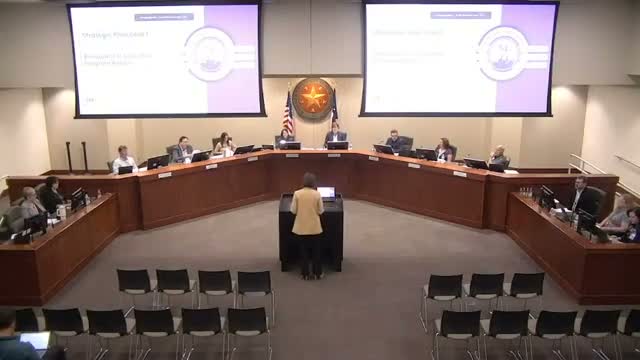
Summary
Director of multilingual programs Triana Fontecha told trustees Boerne ISD currently serves 710 emergent bilingual students and reported stronger-than-regional outcomes on STAR and TELPAS; the district outlined staffing, waiver filings to TEA and planned campus EB support teams.
Triana Fontecha, director of multilingual programs for Boerne Independent School District, told the board Sept. 15 that the district currently serves 710 emergent bilingual (EB) students and has reclassified 93 students as English proficient in the 2024-25 school year. "Currently, our total enrollment of emergent bilingual students is 710," she said.
Fontecha said Boerne's EB students are concentrated in elementary grades (497 elementary; 102 middle; 111 high school) and reported the district outperformed regional averages on state assessments for EB students: "At the 2025 STAAR results... Boerne ISD outperformed both with 69%" in reading, while the region stood at 62%. She said TELPAS progress rates for the district were 61% versus a 50% state/region baseline.
The presentation tied those outcomes to targeted supports. Fontecha described program options (one-way and two-way dual language immersion, content-based ESL and pullout ESL), and said the district will submit required bilingual exception and ESL waiver paperwork to the Texas Education Agency by Nov. 1. She reported the district currently has nine teachers on the ESL waiver and four on bilingual exception status and said Boerne will continue incentivizing teachers to obtain ESL certification (the district reimburses the cost of the ESL exam).
Fontecha outlined classroom- and campus-level strategies: establishing EB support teams to analyze individual student data, rolling out sheltered-instruction professional learning and using an online supplemental platform to support instruction and assessment preparation. She said the district's reclassification process requires a high TELPAS composite score and performance on STAAR or corresponding EOC exams.
Trustees asked for comparisons year-over-year and versus neighboring districts; Fontecha said she would provide year-to-year trend data but noted the district already benchmarks against several nearby systems. Board members emphasized the district's focus on early intervention, with one trustee noting that research shows reclassification by fifth grade is important to long-term outcomes.
The presentation included examples of campus-level engagement — Spanish spelling bees, multicultural nights and a Van Raab Elementary flags display — as evidence of program breadth and community involvement. Fontecha closed by emphasizing ongoing data-driven, teacher-capacity work to sustain language growth across campuses.
Board response and next steps: trustees thanked the department for the report and asked for additional longitudinal comparisons. Fontecha said the EB support teams and scheduled professional learning would continue through the year and that the waiver submission would be made to TEA on the stated timetable.