Get Full Government Meeting Transcripts, Videos, & Alerts Forever!
Get email alerts on the Education Technology topic
No spam. Unsubscribe anytime.
Talbot County schools present AI guidance emphasizing transparency and human oversight
Summary
District staff presented a draft AI guidance for 2025–26, describing a flexible rubric that allows measured classroom use while prohibiting plagiarism and full dependence on AI; board members asked for policy alignment, equity safeguards and cautioned about AI-detection tools that can misidentify non-native English writers.
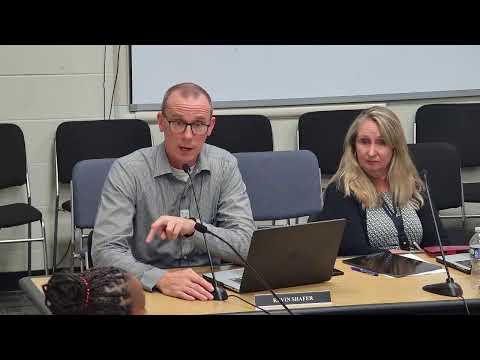
Miss Warner, lead of the TCPS AI committee, presented a draft guidance document for Talbot County Public Schools on artificial intelligence use in classrooms and by staff for the 2025–26 school year. She told the board the guidance reflects months of research and examples from other states and districts and is intended to be a nimble roadmap that supports learning, equity, privacy and human oversight.
The document, which the committee reviewed twice and piloted in several secondary schools, lays out a "SMART" framework for responsible integration: clarifying permitted degrees of AI use, supporting teachers with training, protecting student privacy and keeping human decisionmaking central. Miss Warner said the guidance includes specific prohibited uses—plagiarism, full dependency on AI and uses that enable bullying—and recommends that teachers communicate, in advance, the degree to which an assignment may make use of AI tools.
Board members raised several practical questions. One member asked why the district is presenting guidance rather than a formal policy; Miss Warner and other administrators said guidance permits faster updates as capabilities evolve, and the district plans to link the guidance to existing technology acceptable-use ARs so it is operationally enforceable while remaining adaptable. Administrators also noted the Maryland State Department of Education (MSDE) is working on statewide guidance and said waiting for that update may reduce future local revisions.
Equity and access were recurring themes. Miss Warner noted free, student-focused AI tools were shown to staff and included in the shared Google resource; paid "pro" versions exist but are optional. She cautioned that AI-detection products can produce inconsistent results and may generate false positives for some non-native English writers, a concern several board members echoed as they discussed fairness in discipline and assessment.
Board members suggested the district consider a governance approach that pairs a broad policy with nimble administrative regulations (ARs) and asked that privacy and detector limitations be made explicit in guidance and communications to staff and families. Miss Warner said the committee intends to continue piloting the rubric and to expand presentations to elementary schools, noting some second- and third-grade students are already using AI on district devices.
The draft guidance will appear in the packet for the upcoming consent agenda; administrators recommended the board direct the policy committee to refine the policy/AR linkage and to prepare supporting communications for staff and families. The board did not take a final vote on the guidance at the work session; next steps will include policy-committee review and districtwide rollout planning.