Get Full Government Meeting Transcripts, Videos, & Alerts Forever!
Get email alerts on the Tax Levy topic
No spam. Unsubscribe anytime.
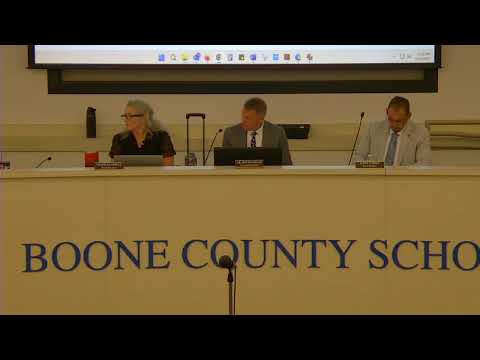
Boone County Board approves 65.5¢ tax rate, FY2026 working budget and expansion of student opportunities
Summary
After a public hearing with dozens of speakers both for and against, the Boone County Board of Education voted 4–1 to levy a 65.5¢ tax rate per $100 of assessed real and tangible property, approved the FY2026 working budget and authorized an expansion of student opportunities.
The Boone County Board of Education voted to levy school tax rates and adopt its working budget for fiscal 2026 after a public hearing in which parents, teachers, students and residents spoke both for and against the proposal.
Chairman Parks opened the public hearing on the proposed tax rate levy before the board’s financial presentation. Kelly Reed of the Boone County Education Association told the board she supported renewing the levy, saying the proposed rate is “almost exact to the penny of what we had 10 years ago” and credited the funding for recent steps to recruit and retain teachers. "We were the first local board to hit a $50,000 base pay for our earliest teachers," Reed said.
Opponents warned of the levy’s impact on fixed-income homeowners. Randy Stegall, a resident of Hebron, said rising home values mean many retirees and fixed-income households would be “significantly burdened” and urged the board to consider administrative cuts instead of raising the rate.
The board heard multiple statements from teachers, principals and students emphasizing the budget’s role in staffing, special education, transportation and extracurriculars. Jerry Gales, a Boone County employee and parent, said the district’s programs and personnel made his community “an amazing place” and argued the incremental tax cost was small compared with benefits to students.
During the presentation that followed, Daryl Denham and Katie Noonan outlined the district’s finances: a current-year assessed value presented at about $23,000,000,000, anticipated revenue of $142,000,000 at the proposed 65.5¢ rate, and an explanatory slide showing the district has lost roughly $10,000,000 in SEEK funding over the past 10 years. Noonan told the board the working budget includes a contingency of 5.6% (the state requires a minimum of 2%).
When the board formally moved to levy the rates as presented, the motion specified 65.5¢ per $100 valuation for real estate and tangible property and 49.7¢ per $100 for motor vehicles. After board discussion about assessment cycles, collection fees and the SEEK funding formula, the levy motion passed 4–1.
The board then approved the FY2026 working budget (motion by Wolf; second by Byrd) and an item described as "expansion of student opportunities"—both passed on recorded voice votes, each 5–0. The consent agenda (items a through tt) had been approved earlier in the meeting, 5–0, and the board later voted unanimously to adjourn into closed session under KRS 61.81, section 1(c) to discuss proposed or pending litigation.
Board members and presenters repeatedly framed the Levied rates as a restoration to a historical average and emphasized continued advocacy to change the SEEK formula at the state level. Multiple speakers asked the public to contact state legislators about the formula if they want lower local rates.
The board’s immediate next steps are implementing the working budget for FY2026 and proceeding with the closed session described on the agenda. The district made the presentation materials available on its website as part of the meeting packet.
Quotes used in this article are taken verbatim from participants during the public hearing and budget presentation.