Get Full Government Meeting Transcripts, Videos, & Alerts Forever!
Get email alerts on the Bond Finance topic
No spam. Unsubscribe anytime.
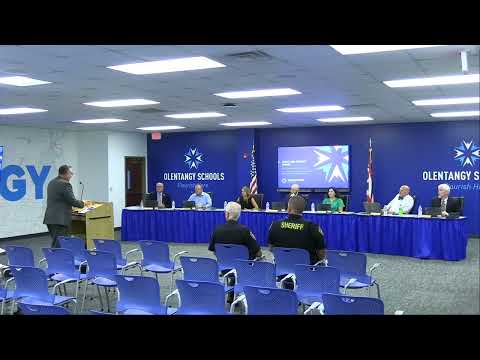
Olentangy board backs $235 million 'no additional millage' bond as enrollment climbs
Summary
The Olentangy Local School District voted to approve consent items that include a resolution committing to a $235 million bond issue advertised as a 'no additional millage' proposal. District leaders said projected property valuation and existing collections would cover new debt service while the bond would fund a new high school and elementary to relieve overcrowding.
The Olentangy Local School District board on Aug. 5 approved a resolution setting the millage limit for a $235 million bond issue that district officials said voters will see on the Nov. 4 ballot with language showing 1.77 mills, but that the district expects not to collect.
Treasurer Mister Jenkins explained the debt-service math at length, telling the board the district’s current collections at 6 mills and the forecasted 2025 property valuation (about $7.2 billion) will cover existing annual debt-service obligations (roughly $33.9 million) plus an estimated $9.5 million in first-year debt service from the new issue. "We will not need to collect any of that 1.77," Jenkins said, describing how state law requires the proposition to list a rate even when the district does not anticipate collecting it.
Superintendent Mister Meyer framed the bond as a response to sustained enrollment growth, saying the district is "right on target" with projections that show long-term increases and pressure points at specific schools. He told the board the facilities plan tied to the bond would fund a new high school (High School 5) and a new elementary (Elementary 18) to relieve overcrowding, particularly at Berlin High School and elementary schools such as Indian Springs and Liberty Tree.
Board members asked how new construction would affect redistricting and operational costs. Meyer said redistricting would be used to rebalance attendance boundaries and that temporary trailers already in use impose recurring lease and operational expenses, constraining instruction budgets. Jenkins noted the district carries a standard six‑month debt-service reserve to avoid default and that construction costs and interest rate risk argue for acting now rather than delaying.
The resolution to set the millage limit and the related treasurer consent slate (minutes and annual commercial-paper report) were approved by roll call as part of the consent agenda. Board members recorded affirmative votes during the roll call.
The district plans additional public information, including materials on its website and voter-facing explanations of what a "no additional millage" bond means. The board will continue discussing the schedule and design work needed to deliver the projects if voters approve the measure.