Get Full Government Meeting Transcripts, Videos, & Alerts Forever!
Get email alerts on the Solar Regulation topic
No spam. Unsubscribe anytime.
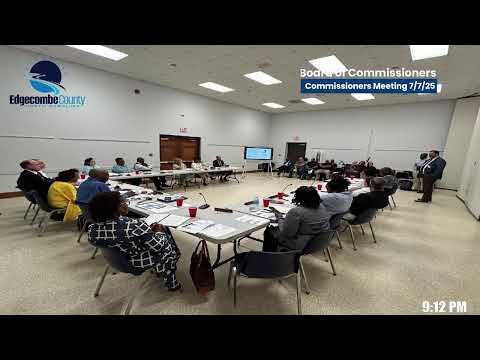
Edgecombe County schedules public hearing after residents press for moratorium extension on utility-scale solar
Summary
After public comments urging stronger protections for farmland and community character, county staff and consultants outlined multiple UDO changes — including zoning limits, development agreements, buffers and decommissioning updates — and the board called a public hearing to consider extending the moratorium.
County commissioners on July 7 scheduled a public hearing in August to consider extending a moratorium on industrial-scale solar farms after several residents urged stronger protections for farmland and community character.
Residents testifying during the public-petition portion urged a pause in approvals until the county adopts clearer rules. Kathy Stallings, a Battleboro Leggett Road resident, told the board she favored “extending the moratorium indefinitely on solar farms,” citing concerns about lost farmland, maintenance and disposal liabilities at the end of a project’s life. Kimberly Gorham Page and other residents also asked for more time to review leases, setback and screening proposals.
County planning staff presented a consultant-produced memorandum summarizing two stakeholder meetings and a planning-board review. Chad Meadows of CodeRight Planners told the board that Edgecombe County’s current approach allows Level 2 and 3 solar uses in every zoning district and relies on a special-use-permit (quasi-judicial) process that, he said, makes citizen participation and negotiation difficult. “If a use meets the standards in your ordinance, it must be approved. You may not deny it,” Meadows said, explaining the legal limits of the county’s present procedure.
Meadows outlined 16 prioritized recommendations developed with stakeholders and the planning board, including: restricting which zoning districts may host large solar facilities or using conditional rezoning rather than special-use permits; requiring development agreements to enable community-benefit commitments and maintenance performance guarantees; establishing maximum farm sizes in some districts (examples discussed included a 10-acre threshold in non-industrial zones); increasing vegetative-buffer standards and planting size at installation (a planning-board suggestion was a 50-foot buffer with three rows of staggered evergreens at a maturity of about 20 feet); and strengthening decommissioning and inspection standards.
The consultant noted state enactments and pending legislation that affect local options. He described Session Law 2023-58 (decommissioning and DEQ bonding requirements) and noted that Senate Bill 587, if enacted and signed, may change the county’s ability to remove solar uses from certain zoning districts or require prior owner consent. Meadows offered three paths for the board: prepare UDO text amendments now within current state law, extend the moratorium and wait for legislative clarity, or pursue a different approach.
County Manager Evans recommended a one-year moratorium extension so staff and the planning board can refine standards and await potential state-legislative changes. A commissioner moved to call a public hearing at the board’s next meeting in August; the motion was seconded and approved by voice vote. The chair clarified that calling a public hearing schedules further consideration and is not itself a moratorium extension.
The planning memo also proposed enforcement and technical steps — including annual third-party inspections paid by applicants, clearer mapping of electrical connections, tighter stormwater/erosion controls, updated decommissioning language to avoid a salvage-value loophole, and possible civil-penalty increases for maintenance failures. Meadows said several items (for example, community- benefit agreements and maintenance performance guarantees) can be implemented through development agreements under North Carolina law rather than purely by ordinance.
Next steps outlined to the board were: (1) prepare UDO text amendments in August if the board elects that route, with a planning-board hearing in September and possible return in November; (2) extend the moratorium and await state-law outcomes; or (3) consider an alternate path. The board set a public hearing for its next meeting to take public input and further action.