Get Full Government Meeting Transcripts, Videos, & Alerts Forever!
Get email alerts on the School Construction topic
No spam. Unsubscribe anytime.
Chariho committee approves Colliers and SLAM contracts to prepare Stage 2 elementary-school plans
Summary
The Chariho School Committee unanimously approved contracts with Colliers (owner’s project manager) and SLAM (architect/engineer team) to produce Stage 2 materials for a five-year elementary capital plan, with community presentations set for Sept. 15–Oct. 15 and a committee decision by Oct. 21.
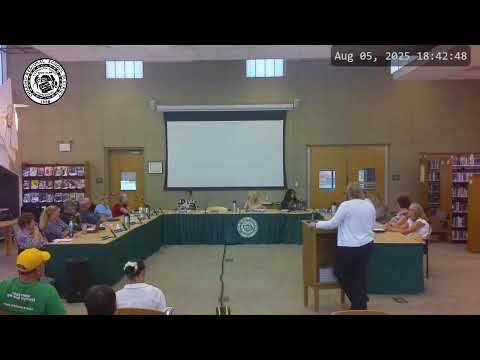
The Chariho Regional School District School Committee on Aug. 5 unanimously approved two contracts to prepare the district’s RIDE Stage 2 submission for elementary-school capital improvements: Colliers as owner’s project manager and SLAM Collaborative to develop conceptual designs and cost estimates.
The chair opened the special meeting saying the agenda was “an abbreviated agenda for capital improvement planning for the elementary schools,” then invited district staff and the two firms to summarize their proposals. Holly DeMaris, director of Colliers’ Rhode Island office, described Colliers’ role as “your eyes and ears on the ground to make sure you’re getting the best…for the money,” and said Colliers bills monthly by hours with no usual retainer. The Colliers Stage 2 fee was listed in meeting materials as $185,000, with a total contract amount shown as $197,000 and an allowance for reimbursables of $12,000.
The committee discussed a delayed Bureau Veritas (state) review and an older Jacobs report from 2016. Members pressed whether Colliers and the Stage 2 process could rely on the older report; Colliers and SLAM both said Stage 2 requires in-depth, site-level work from architects and engineers and that the Jacobs/Bureau Veritas summaries are only starting points. “You really do need due diligence,” Colliers said, noting site visits and engineering reviews are part of Stage 2.
SLAM principal Cathy Ella Thorpe said the firm’s two-part proposal includes a Part 1 set of conceptual presentations—four public meetings across the three towns between Sept. 15 and Oct. 15 and a school-committee session—and a Part 2 that follows the committee’s selection. Thorpe described three paths SLAM had prepared cost options for: renovating existing schools, building one new pre-K–4 school, or studying three new elementary schools. The committee must choose a preferred option by its Oct. 21 meeting for the district to finalize materials for a RIDE submission expected on or before Feb. 15, 2026.
Committee member Jess raised a separate funding concern: bonuses and higher reimbursement levels discussed during earlier planning are no longer available, leaving the district at the base reimbursement rate. Jess said the previous process had offered higher regional bonuses that would have improved the district’s share; committee members and staff acknowledged the district is now estimating reimbursements at a lower base rate. SLAM and Colliers said typical Stage 2 professional fees (OPM and architect) are reimbursable if RIDE awards the project; the meeting materials showed a current reimbursement rate discussed in the meeting of 61% with a regional bonus that could add up to roughly 5 percentage points if applicable.
After brief clarifying discussion about ADA requirements for major renovations and whether projects would require swing space for students, the committee voted to approve Colliers’ contract and then SLAM’s contract; both motions passed by unanimous voice/hand raise. The chair closed the meeting after a final motion to adjourn.
Next steps: the district and SLAM will schedule public presentations in mid-September through mid-October, the committee will decide which option to advance by Oct. 21, and if approved the Stage 2 application materials will be submitted to RIDE on or before Feb. 15, 2026. If RIDE awards the project, Stage 2 professional fees are typically reimbursable at the listed rate.