Get Full Government Meeting Transcripts, Videos, & Alerts Forever!
Get email alerts on the School Safety topic
No spam. Unsubscribe anytime.
Chambersburg Area SD receives annual safety report; district cites weapons‑detection purchases and Safe2Say tips
Summary
Chief Carter briefed the board on compliance with Act 44 and Act 55, completion of risk‑vulnerability assessments at all 18 buildings, purchases funded by a PCCD grant including weapons‑detection systems and a canine program, and district tip and incident statistics (219 Safe2Say tips; 27 life‑safety tips).
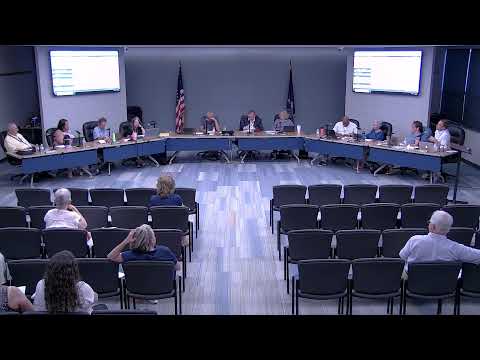
Chief Carter presented the district's annual safety report, telling the school board the district is continuing Act 44 compliance work, updating MOUs with state and local law enforcement, and finishing risk‑vulnerability assessments for all 18 district buildings.
He described recent safety investments made with grant funding, saying the district purchased weapons‑detection systems and a district canine program (handler and canine were trained and recertified) through a PCCD grant and other meritorious funding. Carter said the detection systems will be deployed primarily at large events and may be used for targeted secondary‑school scans as needed.
Carter reported Safe2Say tip activity and other operational numbers: 219 Safe2Say tips this school year, of which 27 were categorized as life‑safety tips (student statements indicating imminent self‑harm); the district coordinates responses to those tips with principals, counselors, Pennsylvania State Police (PSP) and the Attorney General's office as appropriate. Between August 2024 and June 2025, district police handled roughly 1,100 incidents and logged about 1,140 school visits, Carter said. He listed the most common incident types as vaping/tobacco possession, occasional alcohol incidents, disorderly conduct (fights), some THC‑related vaping use, and about 10 incidents involving knives.
Board members asked practical questions about procedures: what a "reverse evacuation" means (Carter: bringing people indoors from outdoor locations), how the district coordinates tabletop exercises and hazardous‑materials scenarios with county hazmat teams and regional task forces, and how bus stop‑arm cameras and the canine program are used to support investigations. Carter said large tabletop exercises include fire, EMS, county command, and regional assets and that hazmat response would scale from district to county to state resources as needed.
Carter also described training and prevention work: mandatory Act 55 training, annual drills (fire, lockdown, shelter‑in‑place, reverse evacuations) and threat‑assessment training carried out with FBI, state police and the Franklin County District Attorney's Office. He told the board the district is focused on triage: screening transient threats, referring higher‑risk cases for full assessments, and deploying social workers, psychologists and family contacts to provide services when needed.
The report was presented in public; the board and administration agreed to brief the board in executive session if any details required confidentiality.