Get Full Government Meeting Transcripts, Videos, & Alerts Forever!
Get email alerts on the School Budget topic
No spam. Unsubscribe anytime.
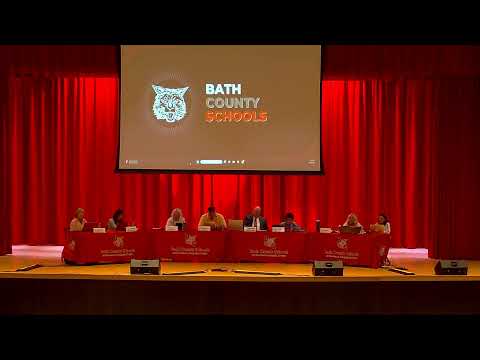
Board adopts 2025–26 tax rates as members debate budget pressures
Summary
The Bath County Board of Education adopted a 63.4¢ real/personal property rate and a 46.4¢ motor vehicle rate for 2025–26; board members and staff warned of lost federal and state funds and constrained capital reserves, prompting discussion about possible cuts or tax increases.
The Bath County Board of Education voted Aug. 25 to adopt the 2025–26 tax rates at 63.4¢ on real and personal property and 46.4¢ on motor vehicles.
Financial staff presented current rates and estimated revenue impacts, saying the district’s current rate was 60.7¢ (real/personal) and that keeping the proposed rate would generate additional revenue compared with the prior year. Staff cautioned the board that, because the state adjusts distributions based on assessed value increases, the district can effectively lose state funding as local property assessments rise. The presenter summarized: for each $1,000,000 in assessed value growth, the district’s state funding net changes by a figure staff described as a loss of roughly $3,000.
Board members framed the decision against a backdrop of declining enrollment, reductions in federal program funding (CTE/Title II/Title IV) and rising facility costs. One board member estimated the district was starting the year with a roughly $420,000 shortfall after a previously missing $300,000 was restored for the current year but not guaranteed for next year. Members discussed potential cuts (including raises) and noted teachers and staff were actively pursuing grants to offset program needs.
Several board members said raising taxes is unpopular but may be necessary to avoid cutting educational programs or staff. One board member, newly seated, said she opposed a recent "nickel tax" pattern and urged fiscal caution this year. The board approved the tax rates by voice vote.
The board also discussed that some of the district’s capital projects and program obligations (reading and math software, MobyMax/Lexia) represent fixed expenditures, contributing to pressure on operating and capital reserves.