Get Full Government Meeting Transcripts, Videos, & Alerts Forever!
Get email alerts on the Policy 22 81 topic
No spam. Unsubscribe anytime.
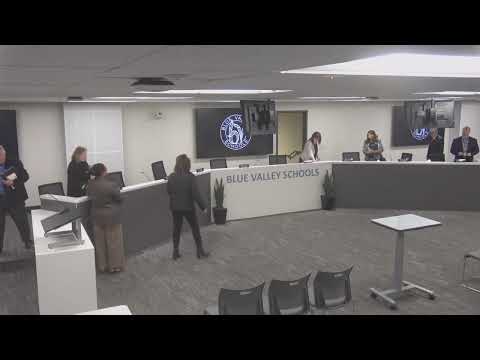
Blue Valley board reviews first reading of policy restricting attendance by people on Kansas offender registry
Summary
At its March 3 meeting the Blue Valley Board of Education held a first reading of Policy 22-81, which would require superintendent and director-of-safety approval for attendance by people on the Kansas Public Offender Registry and presumes denial for those still under supervision; the draft excludes public meetings and facility rentals and will go to public comment before a possible April vote.
The Blue Valley Board of Education on March 3 took up a first reading of Policy 22-81, a proposed rule that would require people listed on the Kansas Public Offender Registry to obtain permission from both the superintendent and the district’s director of safety and security before attending district events.
Melissa Hillman, who presented the draft to the board, said the policy would include a presumption that ‘‘if the offender is still on parole or has state restrictions in place, there will be a presumption that attendance will not be permitted, absent extraordinary life circumstances as determined by the superintendent and the Director of Safety and Security.’’ She told the board the draft does not apply to public meetings or to facility rentals.
The policy author said the district relied on out-of-state policies for a model because there is no current state law or Kansas Association of School Boards guidance directly governing the issue. Hillman also emphasized that administrators would not be expected to monitor the public registry continuously: ‘‘the offender policy is updated every 15 minutes,’’ she said, and the district will rely on direct knowledge if a patron on the registry is present.
Board members questioned whether the policy could infringe parental rights and asked whether families should be notified when a person on the registry is granted permission to attend events. One board member recounted a school practice in which families received a one-time notification identifying an individual who would have supervised access; Hillman said she had not found out-of-state policies that included notification provisions but would look for options.
The board also asked how the draft treats juvenile convictions that can remain on the registry as the person becomes an adult. Hillman said some juvenile records can continue to appear and that, while Kansas does not currently limit where someone on the registry can live relative to a school, supervision terms commonly impose restrictions on contact with minors.
Administrators outlined the next steps: the draft policy will be posted for community feedback (the district said about 30 days, with results returned to the board in April), and the board could revise the draft before voting. Administration suggested the earliest possible approval would be in April, with May as a fallback.
The board’s review on March 3 was a first reading only; no vote on the policy was taken. The district cited the ‘‘Kansas Public Offender Registry’’ in discussion and the motion to enter an unrelated executive session later in the meeting referenced KSA 70 five-forty three-nineteen B-one as the statutory authority for discussing personnel in closed session.