Get Full Government Meeting Transcripts, Videos, & Alerts Forever!
Get email alerts on the County Funding Proposal topic
No spam. Unsubscribe anytime.
Greene County proposes annual town payments and coordinator hire to steady ambulance services
Summary
County officials proposed annual direct payments to towns (example: $100,000 each) plus hiring a county coordinator to standardize purchasing, training and recruitment as a multi-year alternative to immediate full consolidation of ambulance services.
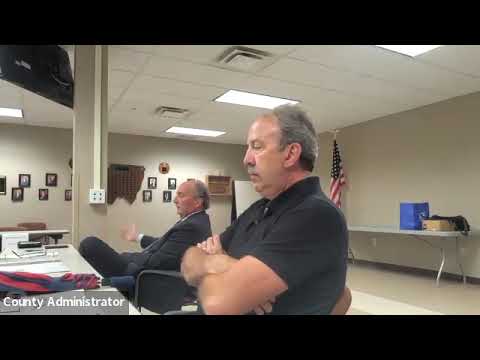
Speaker 1, a county official, told the Greene County EMS Policy Group the county will propose annual direct support payments to towns and hire a county staffer to coordinate procurement, training and recruitment to stabilize struggling ambulance services. "If we gave each town a $100,000 annual donation from the county," Speaker 1 said, "that would be obviously $1,300,000 that the county would absorb," and he framed that payment as a way to avoid a one-year $12–15 million shock from immediate consolidation.
The proposal would also absorb each town's contribution to the FlyCar Green EMS program (Speaker 1 estimated that contribution at roughly $400,000–$450,000) and require recipients to participate in county-led purchasing and equipment standardization. Speaker 1 described the role of the proposed hire as a coordinator who would lead joint purchasing, establish standardized invoicing, push recruitment through schools and manage a phased rollout that could be adjusted in years two and three.
Town representatives pushed back on equity and effectiveness. Speaker 8 said the same flat payment would be a windfall for some towns and insufficient for others, noting mutual-aid burdens and higher real costs for towns that frequently lend crews: "I don't think that $100,000 is fair to the towns that have all sort of been doing this," Speaker 8 said. Speaker 7 called group purchasing a small-step approach that ‘‘is not gonna fix anything’’ absent deeper changes to pay, benefits and staffing.
Supporters argued the approach is practical and gradual. Speaker 3 and Speaker 2 suggested tying some support to call volume or offering reimbursement formulas for towns that provide paramedic-level care. Speaker 1 said the county is already committing to EMT and paramedic training (about $400,000) and sees recruitment programs and standardization as complementary to funding: "We can use it as a stepping stone," Speaker 2 said.
The meeting ended without a formal vote. Instead, the group agreed on next steps to prepare budget numbers and to post a qualifications-based job description for the coordinator role. Speaker 2 summarized the decision to conclude the policy group's routine meetings once the coordinator is hired and to use that hire to push procurement, school outreach and the explorer program.
The plan leaves open several operational questions, including whether billing arrangements would change if Green EMS moved under county administration and how revenue from billing would be allocated. Officials said those details would be worked out as the coordinator, towns and agencies negotiate participation terms.