Get Full Government Meeting Transcripts, Videos, & Alerts Forever!
Get email alerts on the SOL Cut Scores topic
No spam. Unsubscribe anytime.
Superintendent warns proposed reading, math cut-score increases would halve Clarke County pass rates
Summary
Dr. Bowling told the board that draft Virginia Department of Education cut-score proposals for reading and math would sharply raise passing thresholds and, if applied as written, could reduce Clarke County’s reported pass rates from the mid-70s to roughly 39% in both subjects; he urged phased implementation and noted state-board votes in September and October.
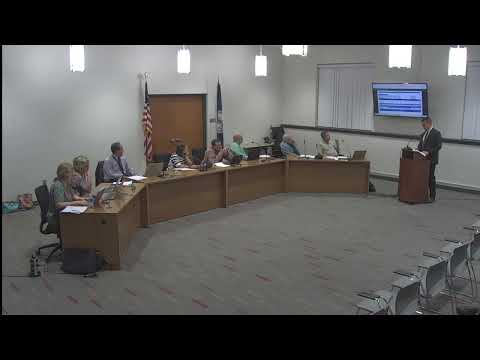
Dr. Bowling presented a detailed review of proposed statewide changes to Standards of Learning (SOL) cut scores for reading and mathematics at the Clarke County School Board meeting on Sept. 22.
Dr. Bowling said Clarke County’s overall pass rate has risen in recent years — from about 68.12% in 2023 to 74.33% in 2025 — but that the state’s draft cut-score recommendations would materially change the thresholds for proficiency in reading and math. He told the board the proposals affect only reading and mathematics at this time, not writing, science or history.
Using the draft motion scores posted by the state, Dr. Bowling presented examples of the new thresholds: several grade-level reading pass cut scores would move from the long-standing 400 benchmark to substantially higher values (for example, an end-of-course reading threshold cited in the presentation would become 479). He warned that, if implemented as shown in the draft, the district could see its reading pass rate fall from 75.87% to about 39.32% and its math pass rate from 72.90% to about 39.3%.
Dr. Bowling described algebra I as a particular concern because algebra I is a required end-of-course test with no substitute assessment; his slides proposed raising the algebra I pass cut score to the mid-400s (around 453 in the draft). He also noted that the state has proposed a new category labeled “approaching” between failing and proficient, but key questions remain about whether that category would carry credit or other consequences.
On timing, Dr. Bowling said the draft scores were posted and that the state board would hear the items for information and action in September, then vote on implementation in October. He recommended a phased and fair approach rather than an immediate, statewide effective date. “I would appreciate a phased in approach that started at the beginning of the school year,” Dr. Bowling said, adding that overnight implementation would be “a very drastic approach.”
Board members asked whether other divisions had filed comments; Dr. Bowling said he had sent a letter of concern and that many superintendents were discussing the changes among themselves. He encouraged local advocacy and said he would keep the board informed as state-board deliberations proceed.
Next steps: Dr. Bowling flagged the state-board schedule (information/action item in September and implementation vote in October) and said he would update the board as votes and implementation details become final.