Get Full Government Meeting Transcripts, Videos, & Alerts Forever!
Get email alerts on the Vacation Washington Ave topic
No spam. Unsubscribe anytime.
Planning commission denies request to vacate 8 feet of Washington Avenue at 226 South Summit
Summary
The Arkansas City Planning Commission voted to deny a request by the property owner at 226 South Summit to vacate the north 8 feet of Washington Avenue; commissioners cited pedestrian circulation, precedent concerns and unresolved historic-right questions.
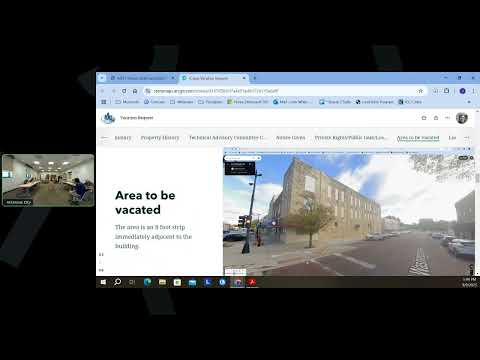
Arkansas City — The Arkansas City Planning Commission on Tuesday denied a request to vacate the north 8 feet of Washington Avenue adjacent to Lot 14, Block 69 (near 226 South Summit). The applicant had sought the vacation to build a porch and improve safety at an entrance that staff said is not currently up to code.
Staff presented the application as filed by Cody Belts and said the proposal would remove about 8 feet of sidewalk space but still leave roughly six feet for pedestrian movement. Staff also noted that final design approval would require review by the historic preservation board.
The applicant told commissioners that while cleaning the building’s basement crews removed roughly 38 tons of debris and exposed remnants of an older exterior stair. The applicant said restoring a porch in the vacated area would improve security, allow relocation of air-conditioning units and remedy hazardous steps.
Several downtown business owners and residents opposed the vacation during the public hearing. Derek Kohler, who said he owns Land Machine Zee Mall and circulated a written letter with multiple signatories, told the commission the downtown master plan emphasizes wider sidewalks and pedestrian traffic; he argued reducing the sidewalk would hurt walking, deliveries and downtown character. Another speaker presented historical photographs and said the sidewalk historically had been open to the public before being filled in decades ago.
Commissioners weighed those public concerns alongside staff testimony that the city’s technical advisory committee had no utility objections. Multiple commissioners warned that approving the vacation could create a precedent encouraging similar requests that would gradually narrow downtown sidewalks and undermine pedestrian-oriented design. Commissioners also debated the difference between historic use and a historic right, with several saying earlier downtown projects in the 1980s had led building owners to forfeit extensions and that changes can eliminate any past claims to keep nonconforming elements.
After discussion the commission moved to deny the vacation. A roll-call vote was conducted and commissioners voted to deny the request to vacate the eight-foot strip; the vacation application therefore failed. The commission left open other potential remedies, noting building owners could explore alternatives such as locking side doors, relocating access through the front of the building or returning with a revised design, and that any final porch design would require historic-preservation and permit review.
The commission’s action was procedural: the denial means the public right-of-way remains in place and no change to the official plat or public sidewalk was approved.