Get Full Government Meeting Transcripts, Videos, & Alerts Forever!
Get email alerts on the Enrollment Demographics topic
No spam. Unsubscribe anytime.
Glendale district hearing: new demographic study shows multi-year enrollment decline; administration outlines leasing, marketing and closure timeline
Summary
Consultants told the Glendale Elementary School District Governing Board that long-term demographic change and parent choice have driven recent enrollment losses; the district outlined a phased plan of staffing audits, targeted marketing, long-term property leases and potential closures to align facilities with projected enrollment.
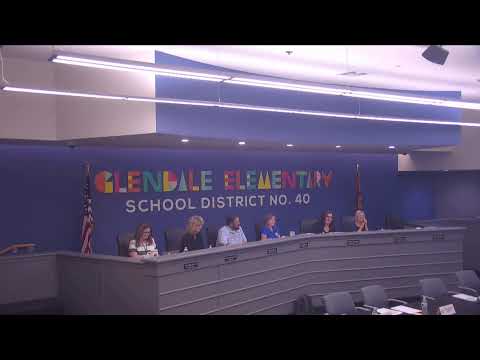
Consultants presenting an updated demographic study told the Glendale Elementary School District Governing Board on June 26 that the district faces continuing enrollment pressure driven by falling birth rates and parental choice, and recommended a phased response that includes staffing audits, targeted marketing, long-term leases of underused properties and possible school consolidations.
Rick Bremer of the consulting team said the analysis relies on detailed student-level mapping and 75 small-area grids dating back to 2002 and showed that the school-age population has declined across much of the district. "Demographic characteristics of the population are very, very important," Bremer said, framing falling birth rates and choice as the chief drivers of the district’s contraction.
The consultants reported recent measures of the district’s universe of school-age residents and enrollment trends: the school-age population fell by about 1,700 over the last 10 years while the district’s actual enrollment has declined by roughly 5,000 in that period. Bremer presented a range of ten-year projection scenarios, estimating enrollment could fall by as few as about 700 students or as many as 2,700, depending largely on how many families the district recaptures from charter schools and ESA programs.
Consultant Kristen Bremer reviewed residential development patterns and the district’s housing pipeline, reporting nearly 3,100 housing permits over the last decade and an estimated 4,100 potential future units across the district. She identified several projects likely to add housing—Legacy Place, Seasons at Trevino (a Richmond American project), Ambra and Bethany Grove—and noted much of the near-term growth will be concentrated in western parts of the district.
Administration outlined a multi-phase financial-solvency and facilities strategy that relies on short-term staffing realignment and revenue-generation through leases, followed by boundary adjustments and selective closures if enrollment warrants it. Miss Sigata Jones described Phase 1 actions including a staffing audit (July 2025–Feb 2026), a market analysis in July, issuing RFPs for property leases by December 2025 and finalizing initial lease agreements by June 2026. Phase 2 actions—new boundaries, staffing alignments and transportation adjustments—are targeted for implementation by July–August 2027 if needed.
On outreach, the district said it will pursue targeted marketing to boost its capture rate: administrators and the superintendent stressed that not all new housing produces school-aged children and that apartment units generally yield fewer students than single-family homes. Superintendent Scott Jones emphasized budget teams use capture-rate estimates to translate new housing into projected average daily membership (ADM).
Board members praised the data and signaled support for a data-driven approach. "We can't control how many babies are in an apartment complex. We can control how good our schools are," President Martinez said, urging a focus on improving and marketing district programs. Miss Sigata Jones told the board the district is currently serving about 56% of the school-age population in-district and said leadership aims to improve that capture rate.
The administration committed to quarterly updates to the board and to transparent community engagement if closures become a possibility. No final decisions about closures or sales were made; the board recessed into an executive session later in the meeting to consult attorneys on pending litigation before returning to public session and continuing other business.
Next steps: the district will complete the staffing audit and market analysis this summer, issue initial RFPs for property leases by December 2025 and return to the board with recommendations on leasing, boundary adjustments and any closure or consolidation proposals as the Phase 1 and Phase 2 timelines progress.