Get Full Government Meeting Transcripts, Videos, & Alerts Forever!
Get email alerts on the Speed Humps topic
No spam. Unsubscribe anytime.
Oakdale council adopts formal speed-hump policy after residents cite local crashes
Summary
Council unanimously approved a new speed-hump policy establishing eligibility, petition and scoring rules for residential traffic calming; staff outlined petition thresholds, design standards and funding options, and residents described recent crashes prompting requests.
Oakdale — The City Council unanimously adopted a formal speed-hump policy intended to create a transparent, data-driven process for residents to request residential speed humps as a traffic-calming measure.
City staff described the resolution as establishing eligibility criteria and a 100-point scoring matrix requiring a minimum of 85 points for installation. Key eligibility and process details staff cited include: streets must be residential with posted speeds of 25–30 mph and average daily traffic under 3,500 vehicles; a minimum street length of 700 feet; required traffic studies that show either 85th-percentile speeds of at least 7 mph over the posted limit or that 60% of vehicles are traveling at an unsafe speed; residents must petition with 75% or greater support from adjacent households; the traffic-safety committee will review recommendations and installation requires separate Council approval for funding and construction.
Staff described multiple implementation options — permanent asphalt humps (typically constructed during road reconstruction), heavy recycled-rubber humps anchored to the roadway, and removable plastic sections that can be drilled into and later removed — and said designs must meet MUTCD, Caltrans and city standards and include advance warning signs and pavement markings. Staff also explained a removal process (greater than 75% resident petition and a minimum 12 months in place before removal) and a five-year waiting period before reapplying after removal.
Several residents urged the change. One resident described a recent collision on River Bluff where a drunk driver struck a parked vehicle in a driveway and said the family will pursue the petition process. Staff offered follow-up contact information and encouraged residents to call the city for details.
Council discussed equity and funding. Several councilmembers raised concerns that a policy that allows resident self-funding could advantage wealthier neighborhoods; staff said the city currently has no dedicated general-fund source for widespread installation but could consider budget adjustments midyear or in next year’s budget to support installs. Staff offered a River Bluff cost example, estimating roughly $5,300 for the removable sections and signage in that example (staff-provided figures in the presentation contained inconsistent per-unit math in the transcript; the council asked for and received the itemized numbers from staff during the presentation).
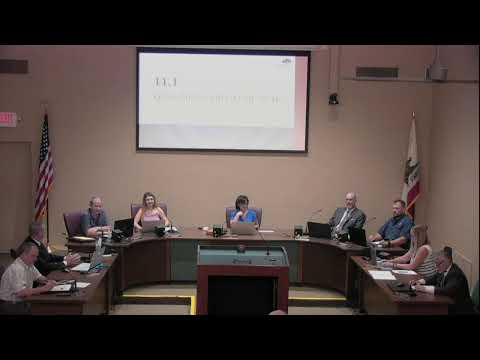
After discussion, the council moved and seconded approval of item 11.1. The roll-call vote was unanimous and the resolution passed 5-0. Staff said residents may begin the petition process and that the traffic-safety committee will evaluate requests before returning recommendations to council for funding and installation approval.