Get Full Government Meeting Transcripts, Videos, & Alerts Forever!
Get email alerts on the Finance Budget topic
No spam. Unsubscribe anytime.
CTA finance staff reports midyear revenue gains overall but fare growth below targets; board hears about $771M funding cliff concern
Summary
CTA presented June and year-to-date finance results showing non-fare revenue and public funding ahead of budget while farebox growth trails projections; staff outlined steps to monitor ridership and lock a 2026 power purchase, and a public commenter asked for contingency plans for an identified $771 million funding gap.
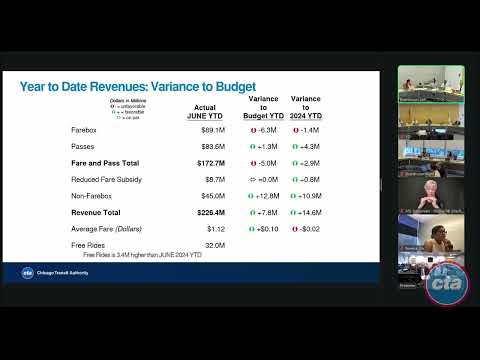
Tom McComb, CTA chief finance staff, told the Finance, Audit and Budget committee on Aug. 13 that June results show mixed performance: fare and pass revenue remained slightly below the budgeted targets for the month but were higher than the prior year, while non-farebox revenue and investment returns were positive. McComb said system-generated revenue was about $7.8 million favorable to budget year‑to‑date and operating expense variances were favorable by about $39.4 million through June. He also said public funding—driven by stronger sales-tax collections and real-estate transfer-tax receipts—was favorable by roughly $12.8 million for the most recent month and about $49.9 million year‑to‑date.
McComb emphasized that June represents the fiscal halfway point and that staff expects to present a 2026 power‑purchase update in September that could affect next year’s budget. "We're comfortable with these results right now," McComb said, while cautioning that fare growth was a few percentage points below internal projections.
Molly Poppy, chief planning and innovation officer, described ridership patterns that partly explain the variance. She said bus ridership has softened relative to earlier projections, while rail ridership is showing stronger recovery in some corridors (she cited 6–7% growth on certain rail segments). Poppy also highlighted bright spots on the frequent-bus network: a set of 12 upgraded routes is outperforming system averages, with examples including the J14 at nearly 20% year‑over‑year growth and a 16% increase on Route 26.
During public comment, rider Brad Matin said a trip home that normally took a bit over an hour took nearly two hours because of construction reroutes, and he urged the CTA to address safety issues—including on‑train smoking and disorderly passengers—without defaulting to policing as the only response. Matin also cited a "$771,000,000 fiscal cliff" and asked what contingency plans CTA has if state action falls short. Acting President Nora Lierz invited Matin to follow up with finance staff and policy leads for details on the RTA and state budget timelines.
Board members pressed staff for context and next steps. Director Raquel asked which drivers produced the midyear gap and whether course corrections were needed; McComb estimated the shortfall at roughly 3% off full-year projections and attributed much of the difference to softer-than-forecasted bus ridership and broader industry trends. Poppy said CTA is continuing investments in frequent‑network reliability, operator hiring and bus‑priority infrastructure to support ridership recovery, and that outreach and performance monitoring would continue.
The committee did not take final budget votes at the meeting. McComb said staff will present additional budget and procurement updates in the coming weeks as the RTA and state processes evolve.