Get Full Government Meeting Transcripts, Videos, & Alerts Forever!
Get email alerts on the Budget And Levy topic
No spam. Unsubscribe anytime.
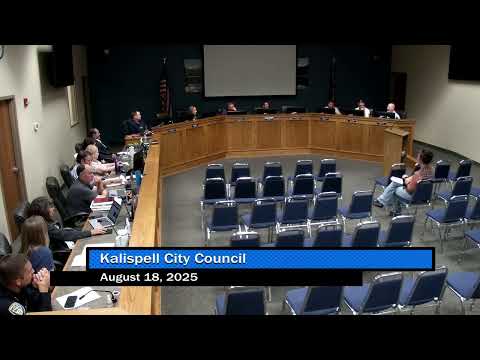
Kalispell council removes 5% impact‑fee admin charge, approves FY2026 budget after heated debate over state law
Summary
The Kalispell City Council voted Aug. 18 to remove a 5% administrative charge from impact‑fee calculations to comply with recently enacted state legislation and adopted the FY2026 budget and related assessments after extended debate about reserves and voter intent.
Kalispell City Council on Aug. 18 voted to remove a previously applied 5% administrative charge from all impact‑fee calculations and approved the city’s fiscal year 2026 budget and a series of special‑assessment levies.
Staff said the change is required by recent state legislation. City Manager Doug Russell told the council the city would remove the 5% administrative component from impact fees for water, sewer, stormwater, police and fire and apply the change uniformly: "We're just gonna remove that 5% so no one can question if there was any portion related to administrative fees going into any of the charges," Russell said during his presentation.
The action came as part of Resolution 62‑76, introduced to comply with what the council identified in the meeting as Senate Bill 133 and related 2025 enactments. During debate, councilors pressed staff on how the city would cover staff time previously funded from the administrative portion of fees; Russell noted some transaction costs such as credit card fees would still be borne by customers who pay by card.
The meeting’s most sustained discussion involved Resolution 62‑79, which implements a state law change converting certain voted levies (an "emergency responder levy") from a mill‑value calculation to a dollar‑based amount and indexing future increases to inflation. Russell explained the option to convert the levy to a dollar amount "would probably have the best short term and even for a very extended period, the best outcome that we would anticipate," while warning the change reduces the previous transparency of tracking mill‑value changes year to year.
Council debate repeatedly returned to two themes: whether the legislature had undermined voter intent and the budget risks of shrinking reserves. Councilor Dowd criticized the state action on principle: "The will of the people trumps the will of the legislature every single time," he said, urging attention to the levy’s original voter mandate. Mayor Johnson also criticized the legislature’s approach, saying, "once again, the legislature goes off the rails and does their stupid stuff without even consulting municipalities."
Councilors split on whether to prioritize tax relief by placing more "mills on the shelf" or to preserve a city policy reserve target of roughly 20%. Several members warned that reducing the reserve now could require cuts to services or jeopardize the city’s bond rating in future downturns; Russell advised maintaining reserves, noting the challenge of rebuilding them once spent.
Despite the debate, the council approved the set of budget resolutions, including Resolution 62‑80 (annual mill levy), Resolution 62‑81 (annual appropriations), and a package of district assessments for storm sewer, urban forestry, street lighting, street maintenance and solid waste. The council also approved budgets and appropriations for the Kalispell Business Improvement District and the Tourism Business Improvement District.
What’s next: Interim City Manager Jared Nygren said staff will bring follow‑up materials to upcoming work sessions, including a requested short‑term parking/code proposal from the school district tied to neighborhood changes. The adopted resolutions allow staff to proceed with FY2026 appropriations and levy collection under the new state framework.