Get Full Government Meeting Transcripts, Videos, & Alerts Forever!
Get email alerts on the Litigation Outside Counsel topic
No spam. Unsubscribe anytime.
Cranston council says it retained outside counsel over OMA complaint, seals executive-session minutes
Summary
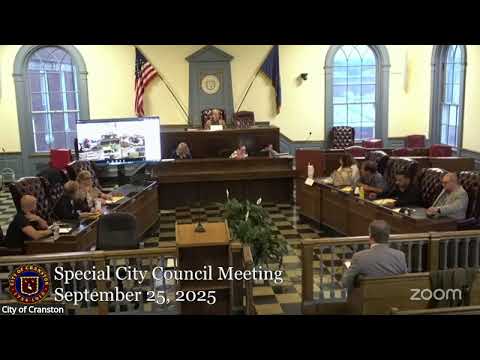
At a Sept. 25 special meeting, the Cranston City Council reported that it approved hiring outside litigation counsel to represent the council in an Open Meetings Act complaint and voted to seal the executive-session minutes; the hiring was approved during the executive session, the council said.
The Cranston City Council reported Sept. 25 that it approved hiring outside litigation counsel to represent the council in an open‑meetings complaint and that it voted to seal the executive‑session minutes.
Council members moved into executive session to consider “a letter of engagement for litigation counsel to represent the city council” in the matter identified in the meeting record as “Drake Patton and Rhode Island attorney general versus the Cranston City Council,” an OMA complaint dated Aug. 21, 2025. The council returned to open session and the presiding officer reported that motions made during the executive session were approved.
For the public record, the presiding officer read a motion reported as approving retention of “Lewis, Brisbois, Bogard, Bogard, and Smith LLP” as litigation counsel and approving a letter of engagement dated Sept. 19, 2025, authorizing the council president to sign and to enter the letter into the record. The presiding officer said the motion was passed unanimously in executive session; the transcript does not include a public roll‑call vote on that specific hiring and does not show the text of any opposing views from the public session.
Before entering executive session, the clerk conducted a roll‑call vote to allow the executive session; during that roll call council members answered ‘Yes,’ indicating unanimous approval to enter the closed meeting for the stated purpose. After the executive session the council conducted a separate roll‑call vote when resuming open session and later recorded a roll‑call vote to seal the executive‑session minutes; those roll calls, as read aloud by the clerk in open session, show members answering in the affirmative.
The meeting record includes the dates tied to the matter: the OMA complaint is noted as dated Aug. 21, 2025, and the letter of engagement referenced in the report is dated Sept. 19, 2025. The transcript does not include details of the letter’s terms, any fee amounts, or the text of the counsel engagement beyond the firm name read into the record; the council stated the hiring decision and the letter were entered into the executive‑session record.
With no further business on the agenda, council members moved to adjourn and the meeting ended.
What the record does and does not show The public transcript records motions, roll calls to enter and exit executive session, and a public statement by the presiding officer that the hiring motion was passed unanimously in executive session. It does not include the discussion that took place in executive session (those deliberations are not part of the public transcript), does not record a public roll‑call tally specifically for the hiring motion, and does not disclose the engagement’s financial terms or the full text of the letter of engagement in open session.