Get Full Government Meeting Transcripts, Videos, & Alerts Forever!
Get email alerts on the Transit Oriented Development topic
No spam. Unsubscribe anytime.
Cotati planning commission backs staff direction on Transit‑Oriented Communities rules, urges ordinance next
Summary
The Planning Commission approved staff-recommended direction to implement Bay Area TOC policies—targeting higher densities near the SMART station, new parking rules, and use of 120 East Cotati Avenue for 100% affordable housing—and directed staff to draft an ordinance ahead of ABAG/MTC grading in Feb. 2026.
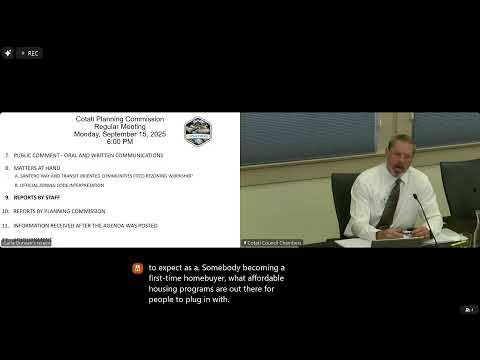
The Cotati Planning Commission on Aug. 18 approved staff recommendations to move forward with implementing Transit‑Oriented Communities (TOC) policies from the Association of Bay Area Governments and the Metropolitan Transportation Commission and asked staff to prepare an ordinance for council consideration.
Staff said the city would apply TOC changes to parcels within a half‑mile of the SMART station and select citywide policies. The proposal includes residential density ranges of roughly 25–35 units per acre in TOC areas; maximum parking standards of about 1–1.5 spaces per residential unit (with some exceptions) and commercial parking roughly 4 spaces per 4,000 square feet (or 1 per 250 sq. ft.); and a commercial floor‑area‑ratio range of 1–3. Staff also proposed eliminating parking minimums in the TOC area.
Sarah (Planning staff) told commissioners the city can meet production requirements by using public land already acquired and by relying on streamlined entitlement rules under Senate Bill 330. Staff highlighted the purchase of 120 East Cotati Avenue, which it said would be used for a 100% affordable housing project and would satisfy part of the TOC production commitment.
Staff described a compliance scoring system used by ABAG/MTC: roughly 40 points is a minimum to qualify for some One Bay Area Grant funding, while 70 points is nearer to full compliance and more competitive for grants. Cotati must be prepared for ABAG/MTC grading beginning in February 2026, staff said, and aims to turn the commission direction into an ordinance by December to meet submission timelines.
Commissioners pressed staff on issues residents raised during outreach, including parking impacts, evacuation and circulation in higher‑density areas, architectural compatibility, preservation of open space, and displacement risk. Staff said the Santero Way specific plan and the city’s Active Transportation Plan and EIR work inform parcel selection and that the city intends to exclude parcels already developed with single‑family homes from the TOC upzoning.
On preservation and protection, staff recommended modest code updates: a slight change to condominium‑conversion language and use of existing mobile‑home protections; a proposed code‑enforcement approach to avoid displacement; and a proposed loan program for low‑income homeowners to make repairs. For commercial stability, staff proposed a small‑business liaison and options such as right‑of‑first‑offer overlay districts and limited financial assistance, but cautioned some preference policies would be difficult to enforce in private real‑estate transactions.
The commission debated funding commitments in the TOC policy. Staff noted ABAG/MTC’s illustrative expectations for small jurisdictions — production roughly $1,000,000, preservation $500,000, protection $100,000 — and said the city’s annual budget is about $11 million, making multi‑year, fixed commitments challenging. Staff recommended relying where feasible on the city’s existing commitments (including the 120 East Cotati purchase) rather than new large, recurring obligations.
Commissioner Gilardi moved to approve staff’s recommendations with his suggested changes; the motion was seconded and approved by roll call. The commission’s vote directs staff to prepare an ordinance and return to the council, and staff said it will submit the city’s materials to ABAG/MTC for grading in the next funding cycle.
The most recent procedural step is the planning commission’s recommendation; any ordinance changes will require formal council action and subsequent ABAG/MTC review and grading.