
Nevada OHV commission splits on grant awards, funds local enforcement and outreach while tabling federal land projects
Get AI-powered insights, summaries, and transcripts
Subscribe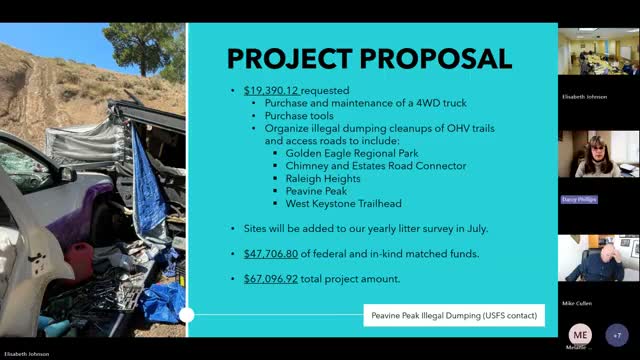
Summary
At its Dec. 13 meeting the Nevada Commission on Off-Highway Vehicles approved several local grants for enforcement, outreach and trail amenities, reduced an administrative fee on a large nonprofit award, and declined or tabled multiple federal land-management applications pending further review.
The Nevada Commission on Off-Highway Vehicles on Dec. 13 heard presentations from nonprofits and law-enforcement agencies seeking grant money for outreach, cleanup, safety media and enforcement, then moved into a long deliberation that produced mixed outcomes.
Most immediately, the commission approved funding for Story County Sheriff's Office's SOHO enforcement and education project, awarding $28,065.78 with a stipulation that the $4,500 radio purchase be sourced from an in-state vendor if possible. Sergeant Beaumont of the Story County Sheriff's Office described the program as a five-person off-highway operations team created in 2023 that does patrols, VIN inspections and event outreach; he told commissioners the unit responded this year to multiple rollovers and a May 2024 crash that resulted in a fatality.
Lyon County's request for a truck and training was pared back: commissioners approved a partial award of $25,607.80, cutting out funding for the pickup and its upgrades and leaving money for upfitting UTVs, training and outreach. Deputy Daniel Boyer said the vehicle was intended to tow UTVs and support patrols across Lyon County's roughly 2,100-mile trail system.
The commission also addressed funding for statewide outreach. The Nevada Off Road Association (Novora) was approved with modifications: members agreed to reduce the applicant's administrative line to 15% (from ~19% in the submitted budget), producing a revised award figure discussed by the body (discussion recorded around $177,611.75 after the change) and directing staff to work with the applicant to remove or reassign several deliverables (charity poker run, certain stewardship/event-assistance tasks and federal permitting assistance) so program dollars remain focused on direct outreach and stewardship.
Several federal projects drew pushback. Commissioners repeatedly raised concerns about awarding money to U.S. Forest Service or Bureau of Land Management (BLM) projects that proposed trail decommissioning, were judged to include activities outside the statutory scope of NRS 4.90, or lacked sufficient landowner letters. As a result, the commission tabled or declined several federal applications for later reconsideration if funds remained.
A recurring theme in deliberations was statutory scope: multiple commissioners cited an attorney-general memo and the text of NRS 4.90 in arguing that the commission should not fund search-and-rescue or broad general-law-enforcement activities and that applicants must demonstrate any such activities are incidental to 4.90-eligible work.
On cross-border programs that serve California and Nevada, commissioners sought parity and limits on Nevada's exposure. The Sierra Avalanche Center requested support for its forecast and outreach; commissioners ultimately agreed to a modest Nevada contribution of $10,000 rather than a larger share, noting California partners also contribute and that the commission must limit funding to Nevada-benefitting work.
The commission left final tallies and several items pending. Staff reported roughly $281,437.36 remaining before Novora's final adjustments; commissioners agreed to revisit a subset of tabled federal projects and a few local items if leftover funds remained.
What happens next: staff will finalize award language and stipulations (for example, requiring in-state radio procurement where feasible and contract terms limiting non-4.90 uses), work with applicants to adjust budgets per commission direction, and return to the commission with final award agreements and any items carried forward from the table.