Get Full Government Meeting Transcripts, Videos, & Alerts Forever!
Get email alerts on the Budget And Tax topic
No spam. Unsubscribe anytime.
La Marque council adopts FY2025–26 budget, approves 2¢ tax increase for debt service in 3–2 vote
Summary
After extensive public comment and staff presentations, La Marque’s City Council adopted the FY2025–26 budget at the current 39¢ rate and separately approved a 2¢ ad‑valorem tax increase tied explicitly to debt service, passing the tax measure 3–2.
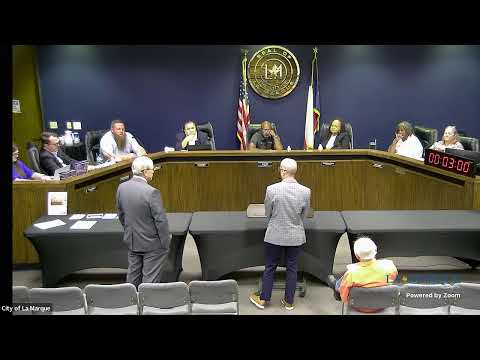
La Marque’s City Council adopted the city’s FY2025–26 budget and voted to raise the city’s ad‑valorem tax rate by 2 cents per $100 of valuation on Sept. 25, 2025, with the council specifying that the additional revenue be devoted solely to debt service.
The council first approved the annual budget configured at the city’s current 39¢ tax rate. After public testimony and a presentation by city staff, Mayor Pro Tem Joe Campion moved that the council adopt the budget. Campion, identified on the dais as Mayor Pro Tem, then proposed a separate, subsequent motion to increase the tax rate by 2¢ and dedicate that incremental revenue to short‑term debt repayment and to preserve the city’s credit standing. “I would like to move that we set our rate with a 2¢ increase,” Campion said during the meeting.
City Manager/Finance staff told the council the budget picture was tight: at earlier modeling the 39.398501¢ baseline generated just over $23 million in revenue while expenses were shown near $22,000,007.69; staff reported $936,221 in identified cuts and freezes that had already been achieved. The administration framed the narrow tax increase as a way to demonstrate fiscal stability to lenders and preserve the city’s bond credibility. “We have saved $936,221,” the City Manager said while reviewing cuts made across departments.
Worth Ferguson, the consultant leading a multi‑year financial review, outlined the scope of a planned five‑year audit and pledged a public spreadsheet for the October meeting that will show which funds and how much of the city’s finances have been reviewed to date. “I’ve been in state government in one capacity or another for over 20 years,” Ferguson told the council as he described his audit experience and the phased timeline for a look‑back and public reporting.
The motion to adopt the tax increase passed 3–2. The council did not record individual roll‑call names in the formal voice vote summary published during the meeting, but the mayor voted in opposition and the motion carried by a three‑to‑two margin. The council immediately amended the adopted budget to allocate the entire 2¢ increment to a sinking fund for debt service, and staff were instructed to reflect that in the ordinance language.
What the increase means in dollars: staff gave an example earlier in the meeting that a 2¢ increase would generate roughly $364,092 in additional annual revenue and that each penny of tax typically produces about $182,000 for the city. The City Manager also told the council incremental increases were intended to improve the city’s ability to obtain short‑term loans and preserve its credit rating while the administration implements longer‑term fixes.
The council emphasized that the tax increase was intended as a temporary bridge tied to debt repayment and bank financing; members also directed staff to continue cost‑containment measures, to publish more frequent situational reports on cash balances, and to provide the audit deliverables that community members have requested. The council scheduled follow‑up finance‑committee work and public reporting in the coming weeks.
The ordinance numbers for the actions were O‑2025‑0018 (budget adoption) and O‑2025‑0019 (tax levy); council staff and legal said the adopted budget will be updated to include the 2¢ assignment to debt service and will be reflected in ordinance paperwork and the October agenda.