Get Full Government Meeting Transcripts, Videos, & Alerts Forever!
Get email alerts on the School Facilities topic
No spam. Unsubscribe anytime.
Chariho officials outline three elementary-school plans; unified campus would be most efficient but raises site and tax concerns
Summary
SLAM Collaborative and Colliers presented three Stage 2 conceptual options for Chariho elementary schools — a unified regional school, extensive renovations/additions, or three new schools — with construction-only cost ranges shown and community meetings scheduled in late Sept./early Oct. Residents raised questions about location, land acquisition, reimbursement and tax impacts.
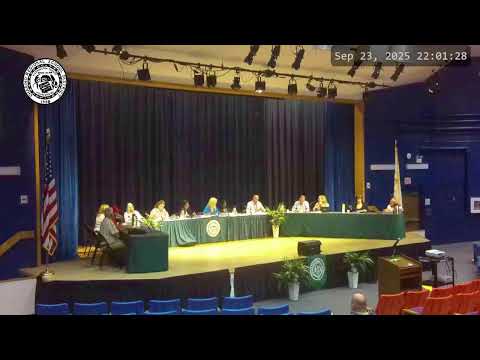
SLAM Collaborative and Colliers presented three conceptual elementary-school options to the Chariho Regional School Committee on Sept. 23, framing the work as a Stage 2 facilities study required by the Rhode Island Department of Education (RIDE).
Mark Rhodes, SLAM’s lead designer, said the study is “conceptual in nature” and that Stage 2 provides the detailed analysis RIDE requires to determine reimbursement eligibility. He said prior reports — the 2017 Jacobs assessment and a Bureau Veritas overview — are high-level and do not replace the district’s Stage 2 work.
The three options were: a unified regional elementary on a single new site (estimated construction costs in today’s dollars roughly $87–$90 million); renovating existing schools with additions (roughly $89–$98.1 million); and building three new elementary schools (the most expensive option). Rhodes emphasized that the numbers shown were construction costs only and that land acquisition, remediation, furniture/fixtures/equipment (FF&E), swing space and other soft costs would add to the total.
Superintendent Gina Picard said the district must submit a Stage 2 application to RIDE and may seek bonuses the state offers for things like security or energy performance, but that bonus eligibility requires meeting strict criteria. Holly Demerson of Colliers, the district’s owner’s project manager, explained RIDE’s formula: eligible per-square-foot reimbursement amounts are prescribed by RIDE and can shift with new RIDE guidance (the presentation assumed the state’s current per-square-foot figure plus an anticipated escalation of about $15/ft in a future update).
Committee members and residents focused on three recurring concerns. First, site selection: a unified school requires roughly 27–33 acres and the district would need a letter of intent for any proposed parcel. Residents warned about locating a single large school close to the main campus and questioned whether voters in the three towns would support a centralized site. "If it goes in Richmond, the odds have diminished that it would pass in all three towns," said a resident during public comment.
Second, cost clarity: presenters and public speakers repeatedly requested that published materials clearly state that the slides show construction dollars only. "Please emphasize that these are construction dollars and not the total project cost," said Simon Manlove, a resident.
Third, operational and transition costs: committee members noted swing-space needs given that prior district swing sites are no longer available, and asked how students would be housed during construction. Rhodes said exploratory civil and environmental work would occur in Stage 2 and that swing-space costs would be a soft-cost add-on the district must budget for.
The committee scheduled town-hall style community meetings so residents can review options and provide feedback: Richmond Elementary on Sept. 29, Charlestown Elementary on Oct. 1 and Ashaway Elementary on Oct. 6 (all at 5:30 p.m.). The district intends to present a single option to move forward at the committee’s October meeting, then submit a Stage 2 application to RIDE in February with anticipated RIDE review in spring, and a possible construction start in 2027 with completion around 2029 if voters approve a bond.
What’s next: the immediate tasks are refining presentation materials to clarify soft costs and reimbursement limits, collecting systematic community feedback at the three meetings, and advancing the preferred option to Stage 2 documentation for RIDE review.