Get Full Government Meeting Transcripts, Videos, & Alerts Forever!
Get email alerts on the Education Legislation topic
No spam. Unsubscribe anytime.
TASB briefing outlines sweeping school bills; Boerne ISD warned to watch rulemaking
Summary
Kelly Rosti of the Texas Association of School Boards briefed the Boerne ISD board on dozens of new and pending bills — spanning school funding, special education, parental-rights and grievance rules, student-discipline changes, and possible fiscal limits — and urged districts to track upcoming agency rulemaking closely.
Kelly Rosti, a government-relations representative with the Texas Association of School Boards, told the Boerne ISD Board of Trustees on Aug. 27 that this legislative cycle produced thousands of bills affecting public education and that several measures now moving in the special session will materially affect district operations and policy. "We tracked over 2,000 that impacted schools in some way," she said, and recommended districts review TASB's bill-summary book and forthcoming rulemaking guidance.
Rosti highlighted the state budget figures cited in TASB materials, saying the biennial budget was cited at $338,000,000,000 with more than $100,000,000,000 set aside for public schools and $1,000,000,000 identified for the Education Savings Account (ESA) program. She told trustees that House Bill 2 remains central to funding discussions and that PEIMS coding changes tied to the teacher-retention allotment could require districts to recheck budget assumptions once TEA issues final guidance.
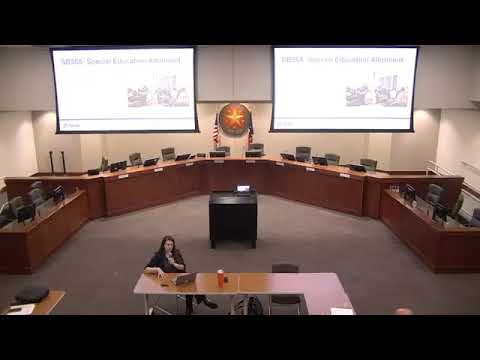
On special education, Rosti said the legislature is shifting toward an "intensity-of-services" funding model recommended by a statewide commission and noted that families using ESA dollars for private placements may receive up to $30,000 for students with special needs. She cautioned that districts remain responsible for special-education evaluations and that while evaluations can cost as much as $5,000 in some cases, the legislature provided up to $1,000 in evaluation funding this session.
Rosti reviewed House Bill 6, summarizing changes to discipline policy: possession of a vape pen by a first-time student no longer requires an automatic DAEP placement, but the bill expands in‑school suspension and requires periodic check-ins for students in ISS. "ISS is now unlimited with check-ins required every 10 days," she said, and added that the commissioner will be required to develop a model return-to-class plan and that threat-assessment teams will include added special-education expertise.
Rosti described cell-phone rules adopted in recent bills as significantly narrowed after negotiations: districts may allow possession of devices but limit use. She noted ambiguity remains over local practices such as permitting device use during lunch or passing periods and said enforcement questions likely will be resolved in TEA rulemaking or by complaint and appeal pathways.
Senate Bill 12 drew extended attention in Rosti's briefing. She described the parental-rights package as establishing notice-and-consent requirements for health screenings and other school activities, requiring new parental-engagement policies, and imposing detailed grievance procedures. Under the new grievance provisions, Rosti said boards may delegate grievance hearings to a three-member board committee; grievance hearings must be recorded and a written decision issued, with timelines for filing and options to supplement the record.
Rosti also warned trustees about measures that alter legal exposure for districts. She described a recently amended bill that reduces sovereign-immunity protections and contains provisions that could criminalize certain vendor contracts when trustees or close relatives have substantial interests or when gifts exceed $250, a change she said could disproportionately affect small districts.
Other items Rosti summarized included changes to testing and accountability under bills she characterized as similar to House Bill 8 and Senate Bill 9 (moving to three shorter, adaptive interim tests per year and requiring two years' notice for major A–F changes), a proposed unfunded mailing requirement in House Bill 17 (which TASB estimated could amount on average to 0.25% of a taxing entity's budget), and a proposed spending cap in House Bill 46 attributed to Karl Tepper that would limit district spending growth to prior-year totals plus population and inflation adjustments unless voters approve an override.
Rosti repeatedly emphasized that many provisions will require TEA and other agencies to write implementing rules and urged districts to monitor rulemaking closely. She told the board that TASB and local legal teams have spent substantial staff time digesting the volume and complexity of changes and offered to provide the district with the TASB board book and more detailed consultative follow-up.
The board asked several clarifying questions during the briefing about timelines, specific local impacts and implementation logistics; Rosti said some items may become test cases and others will be clarified through rulemaking or appeals to the commissioner. There were no formal votes on any of the legislative items during the workshop.