Get Full Government Meeting Transcripts, Videos, & Alerts Forever!
Get email alerts on the Health Professions Building topic
No spam. Unsubscribe anytime.
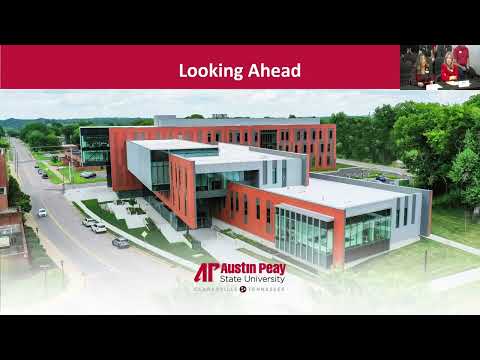
Austin Peay highlights new Health Professions Building as a regional workforce pipeline
Summary
University deans and President Licari showcased the new Health Professions Building, citing simulation-based training, a $1.5 million THEC grant, high placement and licensure pass rates, and expanded clinics that will serve dozens of clients weekly while training students for local workforce needs.
Austin Peay State University trustees heard a detailed presentation on the university’s new Health Professions Building and affiliated training programs during their September 2025 meeting. Deans Dylann Armstrong Williams and Karen Meisch described an interdisciplinary facility built around clinical simulation and expanded on-campus clinics that aim to address regional shortages in nurses, speech-language pathologists and laboratory professionals.
"Our Health Professions building was designed with simulation at its core," Dean Dylann Armstrong Williams said, describing simulation spaces that replicate emergency rooms, home health visits and other real-world scenarios to train students in teamwork, communication and clinical decision‑making. Dean Karen Meisch noted the building supports expanded capacity for radiologic sciences and medical laboratory science, programs with recent three‑ to five‑year average placement rates cited in the presentation as effectively 100 percent for those cohorts.
Presenters cited several concrete supports: a $1.5 million Tennessee Higher Education Commission grant to expand health‑care education pathways, community clinics that can provide 30–40 diagnostic or swallowing‑clinic sessions per week, and summer pipeline programming that welcomed 60 high‑school students funded by the Clarksville‑Montgomery County Health Foundation. The speech‑language clinic expansion includes specialized labs for swallowing and voice disorders and uses in‑room recording technology for instructional feedback.
Trustees and presenters framed the facility as a response to workforce pressures. President Licari said the university recorded a new enrollment high of 11,185 and emphasized the importance of preparing students to meet local demand. During discussion a trustee cited national shortfall projections for nurses and recounted pandemic staffing costs to underline urgency for expanded training capacity.
University leaders also addressed operational questions from trustees about clinical affiliations, fee models and liability. Presenters said the university maintains affiliation agreements and memoranda of understanding with hospitals across the state to secure clinical rotations; student liability insurance is handled through program fee structures. They said the university is still evaluating the proper sustainable balance for community clinic fee models and may charge for some diagnostic tests that carry heavy supply costs while aiming to avoid charging anyone unable to afford care.
The presentation closed with trustees praising the new building and its potential to strengthen Austin Peay’s regional reputation and placement of graduates into health‑care roles. The university held a ribbon‑cutting for the Health Professions Building the day before the board meeting.