Get Full Government Meeting Transcripts, Videos, & Alerts Forever!
Get email alerts on the Budget topic
No spam. Unsubscribe anytime.
Issaquah District projects enrollment drop and tightens budget; state and federal funding changes provide mixed relief
Summary
District finance staff told the board the district expects a loss of roughly 300 students (about 1.9%) in 2025-26, translating to about $4.0 million in annual revenue loss; recent state formula changes and one-time funds narrow but do not eliminate a multimillion-dollar fund-balance decline.
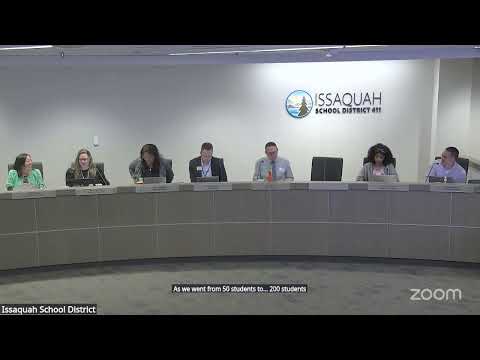
Issaquah School District finance leaders told the board on June 10 that the district faces continuing fiscal pressure as enrollment declines and costs rise.
"We're declining about over 300 students, and that's 1.9% of our current enrollment and equals about $4,000,000 in revenue loss," said Mariah Banasic, the district's executive director of finance and budget. Banasic told directors the district expects kindergarten enrollment to be roughly on pace with projection and noted concentrated growth in some feeder patterns such as Maple Hills and Newcastle.
Chief of finance and operations Martin Tourney outlined recent legislative changes that affect district revenue. He said the state increased the special-education cap to 16% and collapsed two multipliers in the funding formula into a single multiplier (now 1.16), which Tourney said will bring roughly $1.4 million to the district next year. The district also reported a one-time apportionment payment that equals approximately $903,000 arriving in June.
Despite those gains, Banasic said the district's projected fund-balance decline for 2024-25 will be about $5.8 million after the one-time legislative funds and additional transportation dollars, down from an earlier $9.0 million estimate. "We're continuing to monitor spending and revenues closely," she said, adding that the year's decline primarily reflects a planned investment in curriculum.
The presentation flagged ongoing underfunding in key categories, including special education and MSOC (materials, supplies and operating costs). Tourney said the district expects an MSOC increase to provide roughly $860,000 in added revenue but that rising insurance and other cost pressures consume gains: "Insurance just keeps going up and up and up," he said, noting an approximate 11% insurance increase.
Board members asked for clarity about specific funding items and the timing of budget decisions. Several directors and staff emphasized that the district is shifting from expansion to targeted reallocation in 2025-26, moving toward an equity-based budget and preparing a two- to four-year financial outlook ahead of the public budget presentation in August.
Next steps: staff said a complete budget guide will be finalized within the month and that the board will receive a more detailed public presentation and materials in August as the district prepares for bargaining and final budget adoption.