Get Full Government Meeting Transcripts, Videos, & Alerts Forever!
Get email alerts on the Budget topic
No spam. Unsubscribe anytime.
Issaquah School Board holds public hearing on 2025–26 budget amid enrollment decline and funding gaps
Summary
At a public hearing Aug. 7, Issaquah School District finance staff presented the draft 2025–26 budget, citing a projected 346-student decline and multi-million-dollar gaps between actual costs and state funding; the board discussed levy planning, equity-based budgeting, and next steps for adoption.
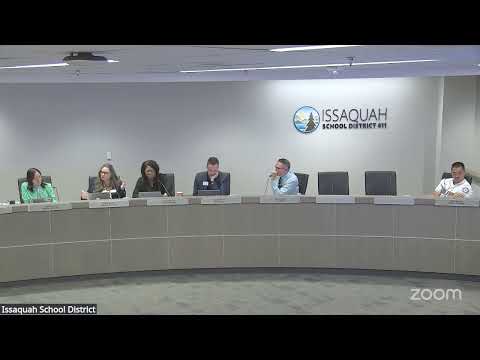
The Issaquah School District Board of Directors opened a public hearing Aug. 7 on the district's proposed 2025–26 budget, during which finance staff described enrollment and revenue pressures and outlined next steps toward formal adoption.
Mariah Banasik, the district's executive director of finance and budget, told the board the district projects a decline of 346 students for 2025–26 and estimated that drop will translate to roughly $4,000,000 in reduced state revenue. She said the district received an increase in the special-education multiplier that brought approximately $1,400,000 in additional funding, but added "there's still a gap between actual costs and state funding of about 9,500,000.0." Banasik also said the district adjusted planned curriculum investments last year, using a $5.8 million ending fund balance for elementary literacy, middle school math, and high school world history adoptions, which reduced the projected ending balance for the coming year to about $46.3 million and lowered the ending-balance-to-expenditures ratio from about 13% to 11%.
Chief of finance and operations Martin Turney outlined the district's revenue mix and levy timing, noting state funding accounts for roughly 70% of the budget, the Educational Programs & Operations (EP&O) levy comprises about 16.6% (more than $60 million), and federal funds represent roughly 2.1% concentrated in special education, Title I and child nutrition. Turney emphasized that the EP&O levy is "critical to the operations of the schools" and described an estimated $4 million increase in local levy capacity that results from calendar-year levy splits.
Board members focused questions on several elements of the draft budget. Director Gallagher asked why special services expenditures rise when the special services enrollment projection is stable; Banasik and others said most of the increase is driven by salary and staffing changes, including temporary staffing and positions tied to prior curriculum adoptions and TOSA assignments. Board President calculated that the special education line represented about a 1.9% increase year over year, roughly matching the overall budget increase.
Directors discussed levy strategy and capital priorities. Director Taylor and others flagged the district's unsatisfied capital and critical-repairs needs after a failed bond proposal in the prior cycle, noting the levy will likely include roofing, HVAC and essential facility improvements. Several directors asked for clearer public-facing materials explaining what the levy would fund and the expected outcomes for students.
Finance staff said unsettled collective bargaining with the Issaquah Education Association (IEA) and federal funding uncertainty remain key budget risks. Banasik said the district is building a strategic multi-year plan to reduce uncertainty and maintain fiscal sustainability.
No public commenters signed up for the hearing; Board President closed the hearing and said the board will consider a resolution for possible action at the next meeting. The district has posted the full draft budget and the budget guide on its website and at the Admin Building.
What happens next: the board will return the draft budget for formal action at an upcoming meeting, after which any levy placements or resolutions would be set for public notices and, if applicable, the ballot timeline.