Get Full Government Meeting Transcripts, Videos, & Alerts Forever!
Get email alerts on the Octa Transit Programs topic
No spam. Unsubscribe anytime.
OCTA outlines ridership gains from student and youth fare programs, previews OC Streetcar service
Summary
Daryl Johnson of the Orange County Transportation Authority told the SB125 task force that OCTA's student and youth fare programs helped triple young-rider trips and that the agency is testing a 4-mile OC Streetcar and 0-emission buses while warning of funding risks tied to cap-and-trade.
Daryl Johnson, speaking for the Orange County Transportation Authority, described OCTA's transit strategy and recent ridership gains at the SB125 task force meeting. He said transit accounts for slightly more than half of OCTA's annual budget and highlighted two student-focused fare programs: agreements with nine community colleges for free student rides and a separate youth-ride-free program. Together, Johnson said, those programs accounted for 16% of all OC Bus rides last calendar year compared with under 5% previously, a change he described as tripling youth and student ridership.
Johnson framed his presentation around "stability through strategy and stewardship," saying OCTA used disciplined planning and conservative financial management to restore service post-pandemic and establish a long-term operating reserve. He described OC Bus 360 long-range planning and connection studies intended to optimize routes and focus service where it benefits the most riders.
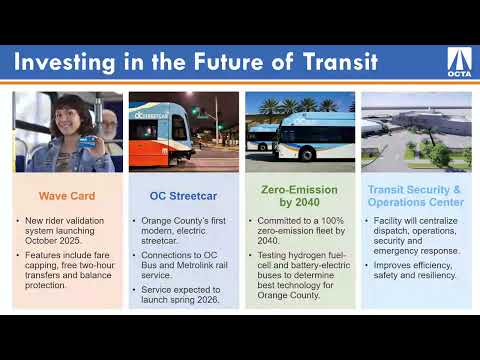
He previewed several capital actions and testing programs. OCTA has taken delivery of OC Streetcar vehicles and is testing a three-car vehicle for a planned 4-mile line connecting the Santa Ana Regional Transportation Center to Harbor Boulevard and the county civic center; revenue service was described as expected in the spring of next year. Johnson also said OCTA is testing battery-electric and hydrogen fuel-cell buses and has broken ground on a new transit security and operations center in Anaheim.
On funding risks, Johnson pointed to concerns about the future of cap-and-trade revenue, saying OCTA identifies about $367 million of projects that would be at risk if that funding stream is not maintained. He urged task force members to consider both the short-term challenges of higher capital and operating costs and the need to invest for long-term ridership growth.
The presentation closed with an offer to provide details on how the community college fare agreements are funded and the specific cost shares now in place; staff said OCTA will follow up with exact figures.