Get Full Government Meeting Transcripts, Videos, & Alerts Forever!
Get email alerts on the Application Fraud topic
No spam. Unsubscribe anytime.
California Community Colleges board approves identity verification and AI tools; agrees to explore nominal application fee with student protections
Summary
After hours of testimony from students, faculty and advocates, the Board of Governors voted to require identity verification in CCCApply and deploy advanced fraud‑detection tools, and separately authorized staff to explore, with students and stakeholders, a capped nominal application fee (no more than $10 or actual cost) with waiver/credit options.
The California Community Colleges Board of Governors on May 9 directed the Chancellor’s Office to implement mandatory identity verification within CCCApply and to deploy advanced technology and AI tools to detect fraudulent applications, and separately authorized staff to explore the possibility of a nominal application fee — capped at $10 or actual cost, whichever is lower — with refund, credit, or waiver protections for students with demonstrated hardship.
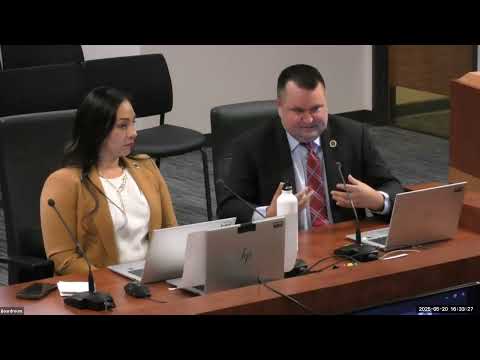
Executive Vice Chancellor Chris Ferguson told the board the system faces “three types of fraud” and that “31.4% of the applications have been determined to be fraudulent,” a figure staff said represents a large share of detection of fraudulent attempts. Ferguson said the package is aimed at ensuring “authentic students on our campus” and protecting classroom seats and financial-aid integrity. He also noted that financial-aid fraud that made it through to disbursement was relatively small in dollar terms — staff cited roughly $10,000,000 in federal financial-aid fraud and $3,000,000 in state aid that reached disbursement — but emphasized the operational burden on campuses and faculty.
The recommended three‑part approach initially asked the board to (1) make identity verification mandatory in CCCApply, (2) authorize deployment of additional AI and algorithmic tools to detect suspicious application behavior, and (3) seek legislative authority to impose a nominal application fee so the system could deter fraudulent submissions and underwrite mitigation. The full three‑part motion failed in the first roll-call vote after heavy public opposition and numerous abstentions.
In response, board members negotiated a two-step path. The board then passed an amended motion directing staff to implement items 1 and 2 immediately — identity verification and AI detection tools in the application funnel — by roll-call majority. The board later approved separate language to “explore the imposition of a nominal application fee, not to exceed $10 or actual costs, whichever is lower,” and to explore “options related to the refund, credit, or waiver of the nominal application fee to students with a demonstrated financial hardship.” The board insisted the consultative process include statewide student bodies and other stakeholders; staff said any statutory proposal would still require full legislative consideration and a future board action before implementation.
Students, faculty and advocacy groups delivered a long line of public comment opposing the fee in concept and urging strong waiver or refund mechanisms if any fee were pursued. “Imposing an application fee, even a small, even an allegedly modest one, builds barriers between socioeconomically marginalized students and our system,” said Annie Kruger, vice president of legislative affairs for the Student Senate for California Community Colleges. Student speakers repeatedly said that even $10 can pose a barrier for students who lack money for bus fare, childcare or meals.
Other voices argued the fee may be necessary as part of a layered response. Board member Amy Costa said the board must weigh fiscal stewardship and the operational cost of fraud prevention, arguing that an eventual nominal fee could be designed to be minimally burdensome and focused on authentication rather than revenue. Several campus and admissions leaders urged immediate investment in technology to relieve campuses’ manual workload identifying non‑authentic enrollments.
Ferguson and other staff emphasized the package was designed as a layered approach — automated detection and identity verification first, with thoughtful consultation and legislative steps if a fee is pursued. “We are not proposing a fee today,” Ferguson told the board during the debate. “We are asking to seek direction so that we have the authority to do so,” he said, but also acknowledged the political sensitivity and legal constraints (including Proposition 26 rules about fees) that shape any legislative proposal.
The board’s action directs the Chancellor’s Office to move forward on identity verification and AI detection within CCCApply and to continue consultation with students, faculty and district leaders as staff “explore” the fee option with a cap and built-in protections; any legislative request and implementation would return to the board and to the legislature for separate approval.
Next steps: staff said they will begin systemwide work to implement the technical changes, gather data on impact, engage statewide student bodies and consultative groups, and if warranted pursue legislative language consistent with the board’s direction. The board’s public discussion underscored the tension between protecting students’ open access and stopping criminal activity that can displace real students and impose heavy operational costs on campuses.
Vote outcome: the initial three‑part motion failed on roll call; an amended motion approving the first two technical actions passed; and a subsequent motion to explore a capped nominal fee with waiver and refund options passed on roll call.