Get Full Government Meeting Transcripts, Videos, & Alerts Forever!
Get email alerts on the County Millage Budget topic
No spam. Unsubscribe anytime.
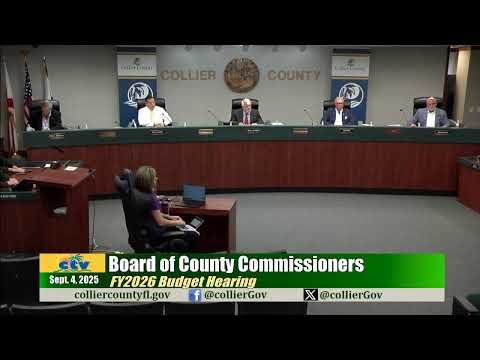
Collier County sets tentative millage at millage-neutral after debate over moving Conservation Collier revenue to general fund
Summary
After hours of discussion about using Conservation Collier revenue to cover a roughly $25 million shortfall, the Board of County Commissioners voted unanimously to set maximum millage at millage-neutral and adopted tentative millage rates and an amended tentative budget; a final hearing is scheduled for Sept. 18, 2025.
Collier County commissioners debated a proposal to reduce the Conservation Collier millage temporarily to make up an estimated $25 million gap while preserving the general fund at the rollback rate, but ultimately voted unanimously to keep the board-adopted maximum millage at millage-neutral and adopted tentative millage rates and an amended tentative budget.
Commissioner Hall proposed an interim reallocation: set the general fund to the rollback rate and "make up" the shortfall by lowering Conservation Collier’s millage for one year while the county’s ResourceX efficiency review proceeds. Hall framed the move as a time-limited step to avoid burdening taxpayers while consultants complete phase 2 of an expense-savings effort. "Any increase in the general fund on the taxpayers bill is a tax increase," Hall said, arguing the plan would let the priority-based budgeting work continue without immediately raising taxes.
Other commissioners raised caution. Commissioner McDaniel and others warned that rolling down Conservation Collier could permanently reduce a voter-approved program and weaken reserves—particularly the capital asset replacement and maintenance (301) fund. Commissioners noted the fund’s voter backing and long-term purpose, and several said they preferred holding to millage-neutral maximums while staff and ResourceX produce more detailed savings estimates.
Following discussion, Commissioner McDaniel moved to maintain the maximum millage at the millage-neutral rates the board set in July; the motion was seconded and passed unanimously. Staff then read the tentative millage rates into the record (the proposed aggregate county rate exclusive of debt service is 3.7675 per $1,000; the aggregate rollback is 3.587, a 5.03% change) and the board voted to accept those tentative rates as read.
The board also voted to adopt the amended tentative FY26 budget, which incorporates the adjustments described earlier in the hearing (routine fund-level adjustments, position reclassifications, and transfers including bond-related transfers). County staff reminded the public that a notice of proposed tax increase will be required in the newspaper if the tentatively adopted aggregate millage is greater than the aggregate rollback and that final rates and the budget will be adopted at the Sept. 18, 2025 hearing.
The debate highlighted a policy trade-off between short-term taxpayer impacts and long-term reserve and program funding. Commissioners said they expect extensive public input before the final hearing and additional detail from ResourceX to inform any future changes.