Get Full Government Meeting Transcripts, Videos, & Alerts Forever!
Get email alerts on the Budget Millage topic
No spam. Unsubscribe anytime.
Collier County adopts FY2026 budget, sets aggregate millage at 3.7675 mills after 3–2 split over Conservation Collier funding
Summary
The Collier County Board of County Commissioners adopted the FY2026 budget and set millage rates (aggregate 3.7675 mills) after approving a millage-neutral budget and directing the spread between rollback and millage-neutral into a capital replacement reserve (301 fund) in a 3–2 vote. The hearing featured extensive public comment on Conservation Collier, land purchases and reserves.
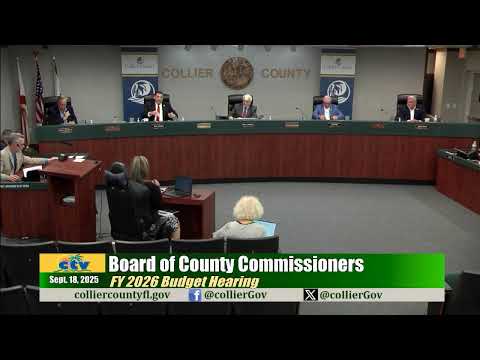
The Collier County Board of County Commissioners adopted the fiscal year 2026 budget and set property tax rates on Thursday, Sept. 18, following a lengthy public hearing and a divided vote on how to treat funding for Conservation Collier.
Christopher Johnson, director of corporate financial management, opened the hearing with the state TRIM-required disclosures and read the proposed millage rates into the record: a general fund proposed rate of 3.0107 mills (rollback 2.8564), water pollution 0.0246 (rollback 0.0233), Conservation Collier 0.2096 (rollback 0.1984) and an aggregate proposed countywide rate of 3.7675 mills (rollback 3.587), a 5.03% increase over the aggregate rollback rate.
Public comment centered on Conservation Collier. Speakers including Michelle Lenhard, chair of the Conservation Collier advisory committee, and representatives from Audubon Western Everglades urged the board to maintain near-full funding and warned that pipeline acquisitions and long-term management obligations require available acquisition and maintenance funds. Lenhard told the board the program had 25 listed parcels totaling about 907 acres with an estimated cost of $17,800,000 pending approval, and asked the board to “support the rollback millage rate of 0.2096 for Conservation Collier.” Brad Cornell of Audubon said the acquisition fund balance at the end of FY25 was about $22,000,000 and that maintenance funds were being held so interest can pay ongoing land-management costs in perpetuity.
Several residents and speakers urged restraint on taxes, questioned whether Conservation Collier holds unspent surpluses, and cited high per-acre asking prices for some small parcels. Commissioner McDaniel and other commissioners clarified that many municipal service taxing units (MSTUs) are geographically limited and that not all residents pay every MSTU rate.
On board policy, Commissioner Kowal presented an option tied to a 5% budget-guidance approach that would reduce millage below the millage-neutral level; Commissioner Hall proposed taking $25,000,000 as a one-time offset from Conservation Collier reserves to avoid raising countywide taxes for FY2026, saying the program remains supported but that spending constraints and market timing justified a temporary adjustment. Hall emphasized he did not intend to terminate or defund the program permanently and said he would restore funding later.
After debate about capital backlogs, reserves and competing priorities — with staff noting capital and maintenance shortfalls in the hundreds of millions and stormwater needs of roughly $300 million — Commissioner McDaniel moved to adopt the tentative budget at the millage-neutral levels and to move the spread between rollback and millage-neutral into the county’s 301 Capital Asset Replacement and Maintenance Fund to be accessed only for project-specific requests with measurable milestones. That motion was made and seconded and passed by voice vote, 3–2.
The board then voted unanimously on a resolution amending the tentative budgets and, after the required reading into the record, adopted the millage rates and the final FY2026 budget by fund in separate motions for dependent and remaining districts. Staff noted the county will submit its TRIM compliance package to the Florida Department of Revenue by Oct. 6.
What the motions mean: the county will levy the millage rates as presented (aggregate 3.7675 mills). The board’s 3–2 vote approved using the millage-neutral framework while placing the excess over rollback into the 301 reserve rather than releasing it for discretionary spending; the approach is intended to preserve funds for capital and maintenance while avoiding a larger immediate tax increase for residents.
Key figures disclosed at the hearing included $1,064,600 in gross budget amendments for FY2026 (exhibit 1b), pending Conservation Collier acquisitions the advisory committee listed at roughly $17.8 million for 907 acres, a reported land-acquisition balance of about $22 million at FY25 year end, and a Conservation Collier maintenance fund figure cited around $47 million. Commissioners also cited multi‑hundred‑million-dollar capital and maintenance backlogs countywide.
The board concluded by thanking budget staff for their work and adjourning the hearing. The final budget and the adopted millage rates will govern Collier County’s FY2026 revenues and expenditures unless subsequently revised per statute.
Votes and actions recorded at the hearing: the board approved (a) a motion to adopt the tentative budget/millage-neutral approach with the spread moved to the 301 fund (voice vote, passed 3–2); (b) a resolution amending the tentative budgets (unanimous); (c) adoption of the millage rates for countywide and dependent districts (unanimous motions as required); and (d) adoption of the final FY2026 budget by fund (unanimous).