Get Full Government Meeting Transcripts, Videos, & Alerts Forever!
Get email alerts on the Land Use topic
No spam. Unsubscribe anytime.
Collier County adopts ordinance to mirror state home‑based business law, adds five‑year grandfather clause
Summary
On Sept. 9, 2025 the Collier County Board of County Commissioners voted 3–1 to adopt an ordinance codifying language from Florida statute 559.955 into the county code, adding a five‑year grandfather clause to protect existing home businesses while staff prepares implementing LDC amendments.
Collier County commissioners on Sept. 9 voted to align local rules with a recently enacted Florida statute on home‑based businesses, approving an ordinance that codifies the state language into the county code and adds a five‑year grandfather clause for pre‑existing operations.
The ordinance—recorded in the meeting as a recommendation to codify 'Florida statues 5 5 9.955'—was advanced by Commissioner McDaniel as a step to reduce subjective enforcement and give code officers clearer standards. "The main premise of this is to in fact mirror our local ordinance with the preemptive statute that was put upon us," McDaniel said during the discussion.
Supporters said the local change will provide clearer enforcement authority for code officers. The county attorney explained that if the county enacts the statute as an ordinance, local code enforcement would have a mechanism to enforce those provisions rather than relying on state officials: "If you enact this as a county ordinance, they could enforce it," the county attorney stated.
Opponents and public commenters urged caution. Jamie Merchant read a letter from Representative Ben Roach asking the board to vote no and warning that codifying the state law locally "could also expose the county to costly litigation," a concern Merchant said could leave taxpayers liable if enforcement overreaches. Danielle Hudson, vice president of public policy at the Naples Area Board of Realtors, said the parking and storage restrictions in the draft could "have a chilling effect on small businesses" in rural areas where landscapers, pool cleaners and contractors rely on visible work vehicles and on‑site equipment. Ashley Jenkins warned of privacy and enforcement risks and said the ordinance's "no fiscal impact" finding understates costs, invoking Fourth Amendment protections for homeowners.
Commissioners discussed technical points the ordinance must match in subsequent land development code (LDC) changes, including how the statute defines vehicles or equipment "visible from the street or neighboring property." The board added specific language creating a five‑year grandfather clause, defined in the meeting as "five years from the date of adoption," to protect long‑standing home businesses from immediate enforcement changes.
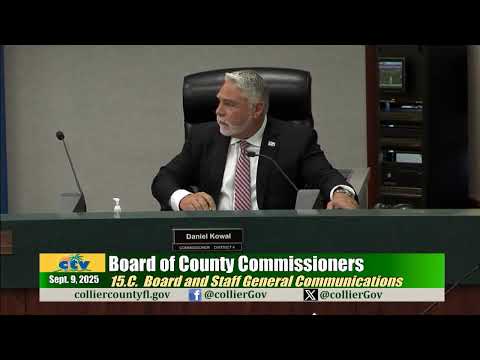
The board recorded the final vote as 3 in favor and 1 opposed; Commissioner Kowal was the lone vote against the measure, citing concerns about enforcement mechanics and the need for a deeper review of the statute's implementation. The county said LDC amendments and additional implementing language will follow the ordinance to address parking, visibility and enforcement details.
The ordinance takes effect following adoption; staff and legal advisers indicated that additional LDC amendments and outreach to affected property owners and business license applicants are the next procedural steps.