Get Full Government Meeting Transcripts, Videos, & Alerts Forever!
Get email alerts on the Public Safety Radio topic
No spam. Unsubscribe anytime.
County consultants outline school radio limitations; recommend in‑building amplifiers and added sites for public‑safety capacity
Summary
Mission Critical Partners told commissioners Collier County Public Schools operate 38 campus radio sites but each site has limited talk‑path capacity; the county’s wide‑area public safety system has higher capacity. Consultants recommended bidirectional amplifiers (in‑building DAS), adding radio sites and targeted coverage testing so first responders have adequate talk paths inside schools.
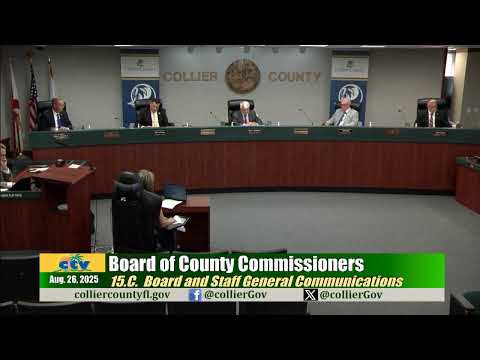
Mission Critical Partners and county telecommunications staff briefed the Board of County Commissioners on Aug. 27 about challenges and options for ensuring reliable public‑safety radio communications inside Collier County schools.
Nick Falgiatore summarized technical constraints: the school radio system is built from many campus‑based sites (38 sites) with small antennas and a limited number of concurrent talk paths (typically 2–6 per school site). By contrast, the county wide‑area public‑safety radio system uses roughly 12 primary radio sites (plus four additional eastern sites) and provides significantly larger talk‑path capacity (22 talk paths). In a major incident at a school (for example an active‑shooter response), the limited talk paths at each school site would be inadequate to support the number of concurrent radio conversations public safety requires.
Because the school sites are compatible with the public‑safety core, radios can be switched to school channels but that requires manual channel changes that interrupt communications with responders on the wide‑area system. Consultants explained why automatic roaming between the wide area and school campus sites is not a practical technical fix; roaming would overload scarce campus channels when radios simply drive past campuses.
Recommended near‑term solutions include: conducting thorough coverage testing in every school to map gaps; adding bidirectional amplifiers and an in‑building distributed antenna system that rebroadcasts high‑capacity wide‑area signals inside school buildings (leveraging the county’s wide‑area capacity rather than overloading campus sites); and, where warranted, adding additional wide‑area radio sites so coverage surrounding schools improves. Mission Critical Partners noted that the school board has already invested significantly in campus sites and has been working with county staff on potential interoperability and bus‑communications transitions.
Commissioners asked for a timeline and for sheriff’s office technical input; staff said those consultations are underway and that the county will return with additional updates and options for procurement and costs.
Ending: Staff will continue coverage testing with the school district, consult the sheriff’s office on system requirements and return with a timeline and cost estimates for in‑building amplification or additional sites.