Get Full Government Meeting Transcripts, Videos, & Alerts Forever!
Get email alerts on the Immigration Enforcement topic
No spam. Unsubscribe anytime.
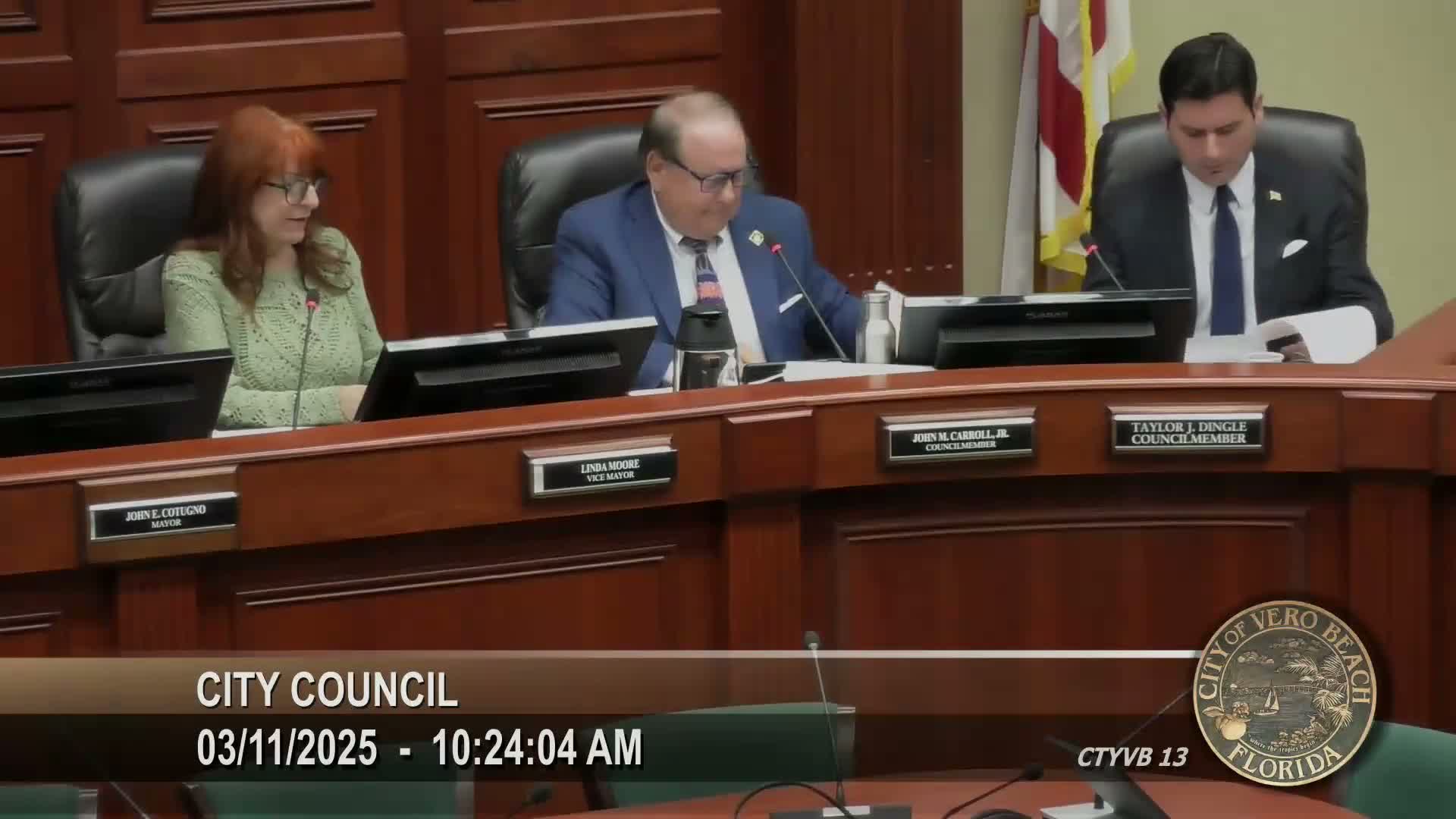
Vero Beach council narrowly approves state-directed immigration MOA after heated debate
Summary
The Vero Beach City Council voted 3–2 to join a state-recommended memorandum of agreement tied to federal immigration enforcement training and task‑force assistance, after hours of debate on home rule, supervision by ICE and enforcement safeguards.
The Vero Beach City Council on a split vote approved a state-directed memorandum of agreement (MOA) that would permit local participation in a task force-style program involving federal immigration enforcement agents and training for local officers.
Councilmember discussion centered on whether signing the MOA constitutes an erosion of local home rule and whether federal supervision of local officers would be appropriate. One councilmember said the measure felt like “an erosion of home rule” and warned it could be “divisive” in the community; another said the memorandum’s language was “vague” on costs and operational details.
Chief Curry, the police chief, told the council the MOA and related task force arrangements are not new, said training is typically four weeks (with a 40‑hour virtual alternative), and that federal agencies frequently partner with local departments. “We’ve been assisting ICE, DEA and FBI for years,” he said, adding that the MOA would allow the city to assist in federal operations if requested and would not automatically change routine local policing practices.
Council members also pressed for details about costs, staffing impacts and the mechanics of supervision. Chief Curry and staff said state and federal funding streams were expected to cover training costs and that local departments would still follow state statutes and the state attorney’s office in charging decisions.
A motion to approve the item passed by roll call; the clerk recorded three yes votes and two no votes (the measure passed 3–2). Council discussion and public remarks were entered into the record alongside concerns about civil‑rights impacts and the need for oversight.
The council’s approval covers participation in the task force/training portion of the MOA; locations and use of personnel would be subject to further operational decisions by city law enforcement and city administration. The item was recorded as approved during the meeting with a 3–2 roll call.