Get Full Government Meeting Transcripts, Videos, & Alerts Forever!
Get email alerts on the Development Agreements topic
No spam. Unsubscribe anytime.
Council Approves First Passage to Waive Jessup In‑Lieu Fee Over Staff Policy Window; Vote 4–1
Summary
After nearly two hours of public comment and council debate, the council voted 4–1 on first passage to approve an amendment that would eliminate or waive the developer's in‑lieu workforce housing fee for the Jessup Irvine Boulevard condominiums, with concerns raised about precedent and use of already‑paid funds.
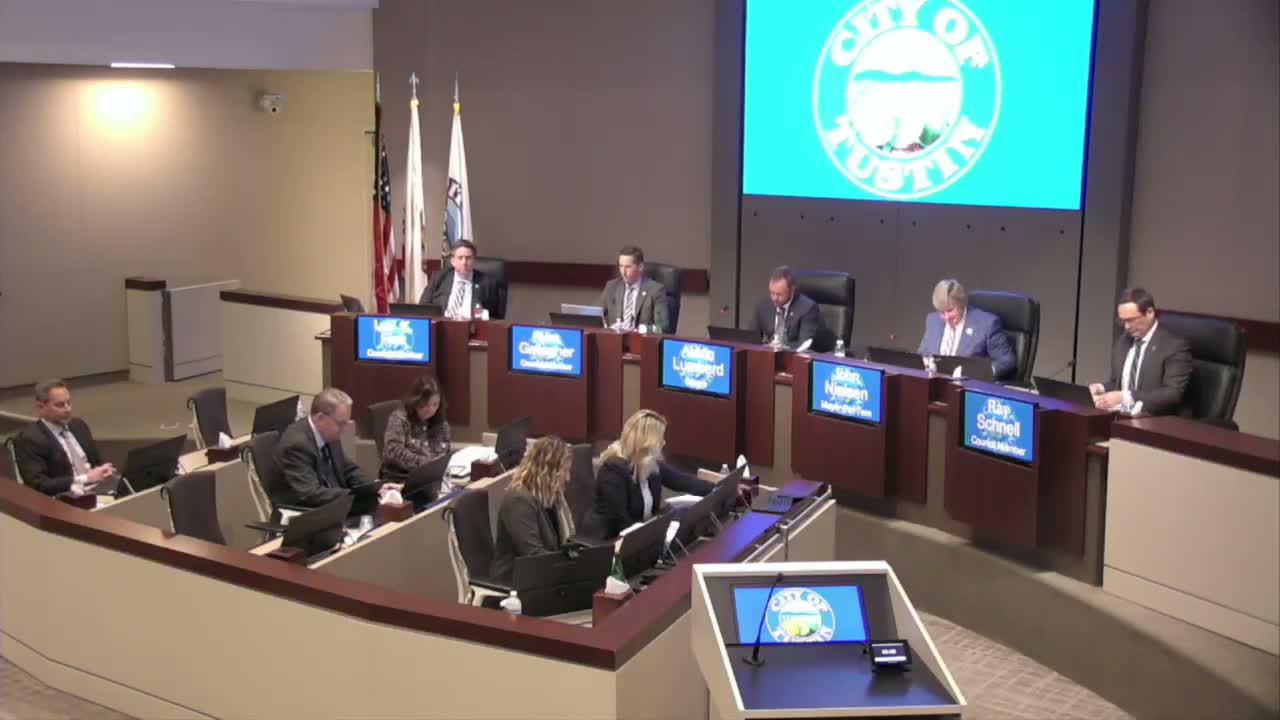
The Tustin City Council voted on first passage on April 1 to approve a request from the developer of the Jessup condominium project to eliminate the project’s previously paid voluntary workforce in‑lieu fee. The first‑passage motion passed on a roll call vote of 4–1 (No: Councilmember Fink).
Principal Planner Ray Berrigan told the council the amendment would remove the developer’s requirement to pay an in‑lieu fee estimated at approximately $290,000. He noted the applicant had sought council approval earlier in September 2024 but the motion failed (2–2–1), and the applicant requested reconsideration.
Public comment was strongly split. Several in‑person speakers (one identifying as Tiago, and others) urged the council not to return fees already paid, arguing the payments had been voluntarily offered as a community benefit, that returning money would set an undesirable precedent, and that the city needs funds to support affordable housing. Several speakers cited figures ranging from about $285,000 to $289,000 when describing the fee amount. Other commenters, including a planning commissioner who spoke from the public lectern, argued the city’s current inclusionary and in‑lieu policies disincentivize redevelopment, pointed to inefficiencies in how in‑lieu funds have been deployed, and emphasized that the Jessup provided two on‑site very‑low‑income units.
Council debate focused on competing policy goals. Councilmember Fink and others opposed refunding fees already paid on the grounds that (1) the housing was built and the public‑benefit money had already been provided, (2) returning funds could create unwanted precedent and potential legal exposure (gift of public funds), and (3) the city should retain funds to support future affordable housing. Proponents, led by Mayor Pro Tem Nielsen and Councilmember Gallagher, emphasized the city’s March policy to temporarily waive certain fees as an incentive to spur development in targeted corridors and said the Jessup amendment falls within that window. The City Attorney pointed to findings in the ordinance recitals that could constitute a public‑policy rationale.
Councilmember Schnell provided financial context, noting the developer had paid other fees (building plan checks/permits ~ $300,000 and park fees about $1,000,000) and that projected property tax revenue from the completed project is roughly $50,000 per year. Multiple councilmembers and public commenters referenced the two on‑site affordable units provided in the development.
The council approved the first passage of the amendment 4–1; the record shows dissent and public concern about returning funds already paid. Staff said the matter had been previously considered in September 2024 and that additional approvals and legal steps remain for finalization.