Get Full Government Meeting Transcripts, Videos, & Alerts Forever!
Get email alerts on the Water Quality topic
No spam. Unsubscribe anytime.
Tustin council adopts 2025 Public Health Goal report; city highlights new PFAS treatment plant
Summary
Council approved the triennial 2025 Public Health Goal report after a presentation from Director Mike Grissow. Tustin said it partnered with the Orange County Water District on a Main Street treatment facility (>$20 million) producing about 8 million gallons per day and removing PFAS to nondetectable levels; the report was approved 5-0.
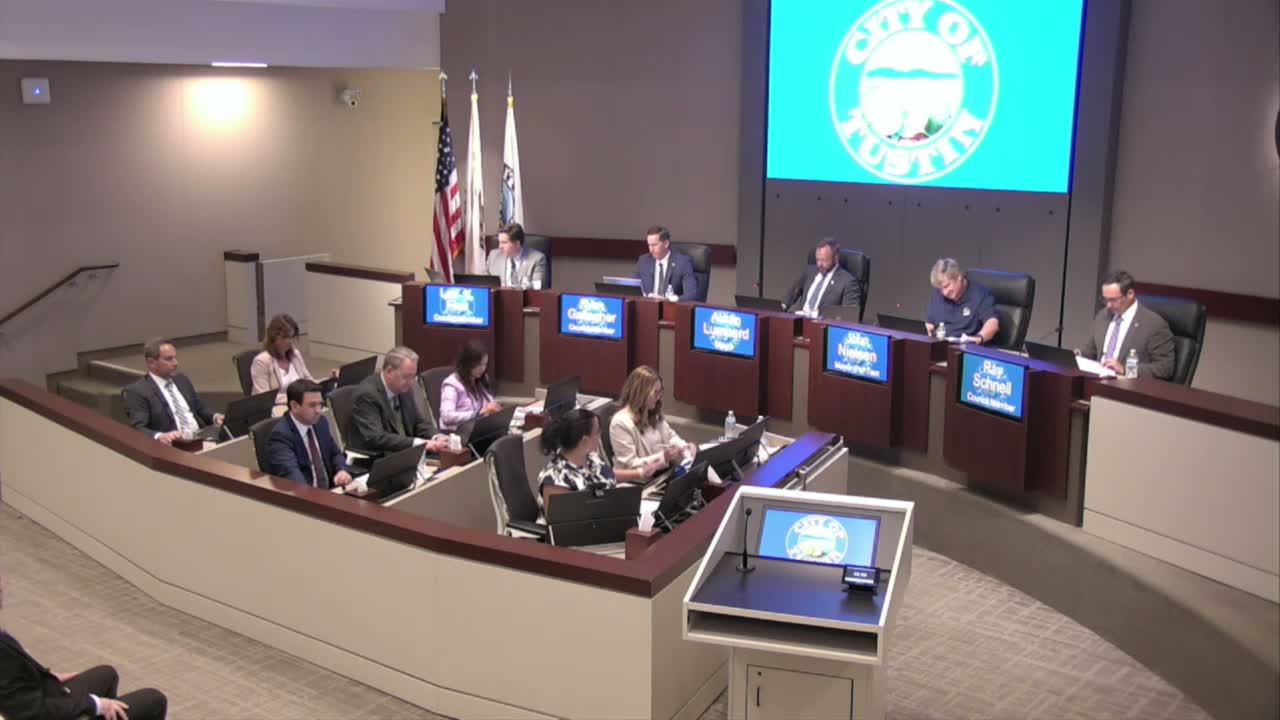
The Tustin City Council on Aug. 5 adopted the city's 2025 Public Health Goal report on drinking water, a state-required triennial report that sets nonbinding health targets and reviews potential contaminants and treatment options.
Director Mike Grissow told the council that Tustin's water meets or exceeds federal and state drinking-water standards but that the public health goal report evaluates additional targets below maximum contaminant levels (MCLs). He described the city's response to PFAS: in February 2021 the city proactively shut down five groundwater wells with PFAS impacts and later invested with the Orange County Water District to build the Main Street treatment facility. Grissow said the facility cost "over $20,000,000," has been online for more than a month, produces about 8,000,000 gallons per day of treated water, and reduces PFAS to nondetectable levels.
Grissow emphasized that public health goals are nonenforceable targets intended to inform monitoring, technology assessments and cost considerations. He also described the city's participation in federal monitoring programs (UCMR rounds) and said the utility continuously monitors for emerging contaminants.
Councilmembers asked whether additional contaminants could require future capital investments. Grissow said it is possible and pointed to ongoing monitoring and the role of evolving science and regulation in shaping future needs. Questions about fluoride drew a response that the city pumps groundwater that naturally contains fluoride and follows Metropolitan Water District and dental guidance when additional dosing by utilities is considered.
No members of the public requested to speak on the item. Following brief council comments praising the city's treatment capacity and oversight, the council approved the report by a 5-0 roll-call vote.